Monday, January 25, 2016

Miyagi or Cobra Kai?

I now take you to your regularly scheduled movie, already in progress:

Daniel: No the problem is, I'm getting my ass kicked every other day, that's the problem.
Miyagi: Hai, because boys have bad attitude. Karate for defense only.
Daniel: That's not what these guys are taught.
Miyagi: Hai - can see. No such thing as bad student, only bad teacher. Teacher say, student do.

And so begins an epic relationship between student and teacher.  When reflecting upon my own teaching, I often find I'm in the Miyagi dojo, as opposed to Cobra Kai.

In the Cobra Kai dojo, there is one master.  The sensei is all knowing and all controlling.  He snaps orders and the students complete the drill in unison.  When he asks a question they answer together, "Yes, sensei!" There is no questioning, no deviation, no discussion.

Students are given very straight forward workouts - practice the jab, practice the round kick.  There is no doubt these students are learning karate. When anyone walks into their dojo they are surrounded by awards, trophies, and other accolades.  The students of this dojo pass all of their tests.  The students win for their sensei and their dojo.

Does your classroom intimidate or inspire?

On the other side of town, Daniel is training with Mr. Miyagi.  Daniel is washing cars, painting fences, sanding floors, and feeling like he's Mr. Miyagi's personal servant... and he tells Miyagi such.  He doesn't see the connection between waxing cars and defeating his enemies.

When he questions Mr. Miyagi about this, Miyagi shows him the connection between painting the fence and defending himself against an attack.  "Show me wax on, wax off." To his surprise, Daniel defends himself against Mr. Miyagi's attack.  He was learning karate the whole time without even knowing it.
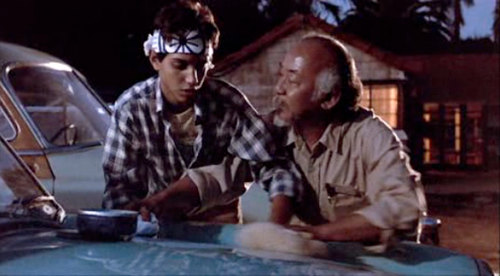
Sometimes 'math' lessons don't have to look like math

Curriculum is just that - curriculum.  It is a series of standards or studies that a teacher must impart onto the students. It is a collection of facts.  Pedagogy is how to best implement those standards, how best to teach the lessons. That is the art of education.

In education there are multiple ways to teach. Pre-service teachers are introduced to Gardner, Montessori, Piaget, and others. Yet I would argue that many teachers and schools model the Cobra Kai style of teaching and development. One teacher, the sage on the stage, preaching a skill with students practicing: I do, we do, you do.  Students in this model get really good at drills.  They pass the tests. They win awards for their teachers and school.

But what else do students in this system learn - or more importantly what do they not learn?  Students learn to be uncreative and unimaginative  They learn to not try alternative methods. They learn to say "the teacher told me to do this way, so I must do it this way." Teacher say, student do.

Many websites (such as AACU) talk about how employers are looking for creative thinkers, problem solvers, and other 'outside the box' innovators.  Miyagi helped produce such a student, and hopefully my classroom will as well.

Yes, sensei


Monday, December 21, 2015

You did what???? WHY???

Sorry for the long break, everyone. It has been a crazy two weeks between school's term ending, my daughter's first high school semester ending, and me heading out to run my first ever ultra-marathon.

Wait. what?

What is an ultra-marathon? Didn't you just finish your first marathon a few weeks ago?  Aren't ultra marathons longer? Why would you ever do that? Do you hate your body that much?

Almost exactly one year ago I started playing with the idea of running a full marathon with the goal of raising funds for Nationwide Children's Hospital.  I had not run anything close to that distance in my life.  I ran my 2nd half marathon in May of 2013, and when I crossed the finish line, I swore I'd never run anything close to that distance again.

You can read more about that on my blog here.

So this past weekend I did what I thought was previously impossible: I finished the Huff 50k (31.5 mile) ultramarathon.  It was an amazing experience.  In fact it led to three very amazing thoughts:

It is amazing what you have left in the tank when you think it is empty. 
How often in life have you felt, "I have nothing left to give." I will say that happened more than once on this journey - during training, during long runs, and during the events themselves.  So many times I thought that I was done - then I remembered that slow progress is still progress. Walking is still moving forward. Resting is an important part of the whole picture. You have more to give.


It is amazing what you can do with a good friend by your side.
This past weekend, my friend Beth and I ran the entire 31.5 miles together.  We were both completing our first ultra, and it was great to share that experience.  I had a mini freak outs ("OMG we've been running over two-and-a-half hours and still have freaking 20 miles to go!!!) She had mini freak outs, but when we did the other was there to just keep us grooving along, sticking to the plan, putting on the illusion of loving life... and saying something that will make you laugh.  She got me through it and I got her through it.

The end of the run was one of my favorite memories, and not because "I was done."  Nearly all of our friends that had made the journey were waiting at the finish line.  Some had finished their shorter 10 mile race hours and hours before, and other finished their 50k well more than an hour or two before us.  Still others didn't even run and stayed at the park for eight hours.  Any of them could have gone back to the house, showered, eaten, slept... but they didn't.  They stayed at the park in dreadfully cold conditions just to watch us finish, and when we did their smiles and joy were so important to me.

I think this happened about mile 20.

It is amazing how many people underestimate what they are capable of doing.
Doing the unthinkable makes everything else a little easier.  How many people in your life have told you they want to accomplish something: start their own business, publish a book, run a 5k.  After you have done 'the impossible', everything else seems a bit easier.  Your perspective on 'normal' and 'possible' shifts.  Your self-confidence and determination increase. You feel what you really have in your tank.

So in about year I went from someone that could kind of finish 15 miles in a week to someone that could finish over 30 in one run.

I have to ask: As we are getting ready to ring in 2016, what impossible task will you accomplish?

You really can. Seriously.

Saturday, November 28, 2015

History is Many Things, but it is Generally NOT Glitter and Unicorns

I hope everyone (that is those that live and celebrate in the States) had a healthy and happy Thanksgiving!

As the leftovers were being cleaned up, I was reflecting on the year as well as the holiday itself - specifically how it is portrayed in schools.  My daughter is in elementary school and as such she did the typical Thanksgiving celebrations - turkey word searches and decorated pictures of pilgrims.  However, it made me think of something my colleague mentioned this month.

My middle school recently returned from a 4 day trip to Washington D.C.  It was a fantastic expedition during which we visited so many amazing and historical places.  Our students did an amazing job, pushing 13 hour days, over 10 miles of walking, and absorbing as much information as their minds would allow.

We were also part of a wreath laying ceremony at Arlington

The trip also showed our social studies teachers one of the problems with teaching history in American schools.  The focus on curriculum is not where it needs to be.  Students in 7th grade should have a solid understanding about the workings of the US government - the branches, the balance of power, the role of each branch.

She believes that elementary school students should not be directly taught 'history.'   History is NOT glitter and unicorns.  History is dirty.  Many of the topics are not appropriate for younger students due to their graphic nature.  Events are rarely black and white - good or bad.  Unfortunately elementary school students are not (nor should they be) exposed to this, and so they are raised with a strong cultural bias.

Ask younger grade school students about Columbus and they can tell you all sorts of "facts." He sailed the ocean blue in 1492, he found America, he proved the world was round, he traded with the Indians.  Then the pilgrims came, had a rough go of it, made friends with the Indians, who helped them survive before they vanished in the woodlands.

How we teach it

Unfortunately, many of those 'facts' are not true, and the ones that are are very much open to debate and perspective.  Elementary schools paint a pretty picture of colonization because, appropriately, the truth of how Columbus treated natives shouldn't be presented to 7 year old children.

And that is the problem.  We are teaching our younger children incorrect history, giving them part (specifically an anglo-american part) of an intricate story, and sending them on their way... and then middle or high school teachers have to be the 'bad guys' and 're-teach' students.  We have to explain that there have been multiple genocides, not just the one in Germany, and one occurred on the land on which we are currently teaching.  And when we bring this up, teachers are met with anger and disgust from both students and parents.

What isn't mentioned

The question she brought up was why not teach government and other objective topics in grade school.  Let's get students into middle school already knowing the different branches of government, the major historical documents, and how the Constitution is arrange.  Teach them about the electoral college.  Teach them about the different branches and their respective responsibilities.  Have them understand the difference between a democracy and a republic.

I certainly don't have a perfect answer - truth be told this is outside of my area of expertise.  But she did bring up some great points and I'm curious what other educators thing about this opinion.

Friday, November 20, 2015

Ripcord - Behavioral Managment Systems That Don't Go Splat

Thursday night on #mschat we talked about Social Emotional Learning and its importance in education.  I brought up part our behavior management system, specifically our 'ripcord' system.

During class, students go through a range of emotions - excitement about a new topic, frustration about being the 'only one' in the class that doesn't 'get it', and everything in between.  Our students take a class called 'brainology' where they learn about brain development, learning styles, and how emotions can interfere with learning. They learn that when someone is overstimulated or overwhelmed emotionally,  the amygdala goes into gear and higher function thinking gets shut down.  When this happens, people are more likely to say or do things that they may regret later.

Enter the ripcord.

In skydiving, a ripcord has a specific function - specifically to save you before you go splat.  However, there is a certain timing to pulling your ripcord.  Pull it too soon and you don't get to feel that freefall experience.  Pull it too late and the parachute won't be enough help to save you.

Much like the classic Atari 2600 game. 

This is the analogy our amazing school counselor uses for our students.  When students are overwhelmed emotionally (usually due to anger or frustration, but possibly because they have a laughing fit coming) they are encouraged to pull their ripcord.  We talk about timing when it comes to pulling a ripcord.  Pull it too soon and you won't learn your limits and abilities. Pull it too late and you'll go emotionally splat.

Each classroom has a ripcord area.  In this area are pre-printed sheets.  Students take a piece of paper and express their emotions.  Younger students identify their emotions by circling emojis, and then draw how they feel.  Older ones draw, circle words, or write their own.  The goal is to get them focused on the problem and in the process of doing so, re-connect all parts of their brain.  Once the student has calmed down, their teacher has a conversation with them about how to best return to class.


This system helps on many levels.  It gives students the power of self-management.  It allows students an 'out' before they say or do something that would be unacceptable.  It acknowledges that students (and teachers - yes, we have ripcord rights too!) get frustrated at times and a time-out is sometimes needed.  It also puts the teacher in the role of a coach and ally, not a cop looking to write someone up.

Would this system work in your setting? Please contact me or leave a comment below!

Saturday, November 7, 2015

Where have you been? Mediocreing?

The problem (for me) with blogging is twofold:

a) not having anything to write about because
b) I have so much I WANT to write about.

It becomes an endless cycle of 'list topic, start blog, ohh squirrel!'

Then I realized something.  This is what happens with teaching as well.  By this point of the year we're all 'in our groove', first term (or so) is finished, and we're hitting the main stretch of the school year.

Of course by groove I mean not-being-able-to-get-into-a-rhythm-due-to-all-the-holidays-and-days-off.

It is really easy at this point of the year to just lean back on the culture and routines you've established and just coast through winter break.

"What's the point of getting this fantastic lessons ready when I have a 3 day week then a 4 day week then a 2 day week, then just about two weeks, then winter break? I mean the students are going to be so disengaged that I'll just do this easy lesson and it will basically do the same thing."

Fortunately for you, the amazing teacher inside of all of us is shouting at full lung capacity:

As teachers, we need have many responsibilities, but there are also things we are NOT responsible for doing.  We are not responsible for 'getting through material' with 'easy to create' lessons.  We are responsible for sparking life long learning.  We are not assigned to stuff knowledge into student's heads.  We are assigned for opening, and then blowing up, our students' minds (more on this on my next blog!) 

A big push in education is student engagement.  Are students asking questions? Are they showing grit?  Are they moving up Bloom's taxonomy? 

Here's my question: How can you expect your students to be engaged if the TEACHER isn't engaged?  

You are responsible for your students engagement, and it starts with you.  If you are creating safe lessons, lessons that don't excite you to teach, lessons that you are bored even thinking about, how can you expect your students be engaged to learn?

As Dave Burgess, author of Teach Like A Pirate says, "Safe lessons are a recipe for mediocrity at best."

And you did not wake up today to be mediocre.

Thursday, October 15, 2015

I Was Literally Speechless... And That's Not Easy To Do.

I got into a great discussion on #twitter last week.  It involved 'retakes' and 'grades.'  Specifically the discussion revolved around two questions:

a) should students be allowed to retake quizzes and tests
and
b) what is the maximum grade they should be allowed on a retake.

I already have a post that touches on this topic.  That one is titled Maureen Shouldn't have to Deal with This...  If you have not read this, I would strongly encourage it.


For those of you that have read my blog already know my opinion on this, but I feel it is important to re-address because it came up in a tutoring session as well.  A student, we'll call her Abby, had gotten an unusually low score on a test.  When we looked it over she admitted she did not study for the test, didn't ask questions, didn't prepare... she was not ready for this test and knew the 37% she scored was an accurate reflection of her efforts.

So we looked at the test and analyzed what we needed to work on to improve her score.  We looked at the topics and learning targets and I set up a plan for her to learn the material.  When she looked at the plan she told me she wasn't going to do all of that.  I was kind of taken back because Abby is typically a hard working student.  I was curious and asked her why she didn't like the plan; was it too hard, did she not like the teacher... what was up?

What she told me solidified my belief in retests.

"What's the point of studying all of it? I can only get a 60 on the retake."


Only a 60? So students that need to retake this test only need to know 60% of the material? Are you saying they can ignore 40% of the material?  Two days out of five are not important enough?   "It's not fair to give a kid an 'A' if it takes three tries" is essentially saying, "it's ok if you don't learn this; it's just a number on a piece of paper" (or on a computer in most cases these days.)

I looked at Abby after she said that and was at a loss for words.  As an educator I felt hurt, confused, and frankly a bit connected with her.  She was right - why should she put in the effort and energy of studying all of the material if she wouldn't be recognized for her work?  Why learn all three learning targets when one will get her enough material to max her score on a retake?

I could not on any level try to justify why she should spend hours of her own time reviewing material when her teacher has essentially told her, "it doesn't matter how well you do this next time, it doesn't matter how hard you work or study, you can only get a D-."

I wondered about the learning philosophy of the classroom.  Was the philosophy "you must learn all of this material in this format by this date" or "you must learn this material." I wondered how students could get motivated to study for a test they knew they couldn't get better than a D-.  I wondered how this fostered 'hope' in students.   I wondered how that policy instilled a sense of awe, wonder, and passion of learning in students.  I wondered why this adult was standing in the way of a student's learning instead of pushing them to feel the internal flame to NEED to learn the material.

But most of all I wondered what I could do to get these policies changed.  

Monday, September 28, 2015

#tweet your learning

Processing is one of the most important aspects of learning, and yet is often one of the most overlooked areas of education.  Students need time to reflect on what they have learned, have time to digest new information, and connect it to previously learned material.  Reflection ensures students are fully engaged and making meaning of the material - producers and not just consumers.

Over the next few blogs, I am going to talk about some of my favorite processing tools in the classroom.  These activities allow students to actively internalize information, have them use different cognitive skills during the activity, and have an element of fun or interaction which I also enjoy.

The first activity is "tweet" your learning.  I am not yet at a point where students have active twitter accounts (though I'm working on this!)  However, using a subpage on classtools.net called Twister, students create a tweet to tell me one important fact they learned from the day.

I love this exercise for many reasons.  Students can only give one 'tweet',  and so they only get 140 characters.  They have to be precise with their vocabulary and word choice. They start reflecting on 'what did I learn' and 'how can I summarize this so succinctly.'  Students are actively forced to use different types and levels of metacognition.

When students get to the site they have four fields to complete: name, nickname, tweet, and date.

On the surface, students can write their name their 'nickname' and give a tweet  and a date.  So, in theory a final product could look like this:

This tweet would definitely meet the expectations.  It told me one fact and even had some of the vocabulary we discussed.  While this is all great, one of my favorite aspects of this site is that it comes pre-populated with different images.  If you type a popular name into the real name field, it will use that person's (or creature's) picture in the tweet.  I showed this example to the students:


This tweet also shows comprehension of new concepts, but does so from a different perspective.  The tweet itself shows a dino misinterpreting those darn kids with the actual object in the sky.  The date, 65 million BC, matches the researched date of when the extinction level event occurred.

They then download the tweet as a .pdf and then upload the file into our digital dropbox.

The students really enjoyed this and don't realize how much thinking they are doing.  I got so many wonderful responses.  Here are a couple of student examples:


What would you tweet about what you learned today?  Who would you use as your avatar?