Monday, January 10, 2022

2022 #OneWord

 I have been thinking on my 2022 one word for quite a while.  Usually words come to me rather quickly. Last year, recenter, was almost instantaneous... but this year I struggled, so I decided to just do a brain dump...

As I brainstormed, there were so many words that came to mind, some of which included:

  • enrich
  • learn
  • expand
  • selfish

    I really reflected upon what these words had in common.  The last one, especially, since it was really unexpected. I am not a selfish person by nature. I have always thought of myself as an everyone-else-first kind of person. So I was a little shocked when this word came to mind. 

    It has been a long year. for everyone. I and I mean everyone. Teachers, students, staff members, parents, flight attendants, the medical community... everyone has been overwhelmed... Even that group of people that you think are doing really well. They aren't. They're struggling.

    2020 was a horror movie. 2021 was the sequel to the horror movie. And we all know there is not a single horror film where the sequel was better than the original. 

    Possible consideration for...

    Still, what did my brainstorming mean?  Finally I saw the connections and a word came to me that encapsulated what I needed.

    Control


    2021 was out of control. As much as I tried to (and successfully did) recenter many aspects of my life including family, friendships, and running, I didn't have control over so many other aspects.  The problem was that I didn't realize (or want to admit) there were hundreds...thousands...millions of things OUT of my control... but I still wanted to control them. How many students were in class... Who was out sick... If classes were virtual, in person, or some hybrid plan. If friends or colleagues wanted to talk. or text. or video call.  I had control over none of these things, yet I wanted control over all of them.  

    When I reflected over what I needed... it was control. Not control over things that I didn't have power over, but control over things I did. Control over my emotions. I'd lost that in 2021. In 2022, I will focus on what I can control:

    • I can control my actions.
    • I can control how I treat others. 
    • I can control my responses. 
    • I can control what time I go to sleep. What I eat. What I watch. 
    • I can control my effort. 
    2022 is all about controlling what I can control... and doing my best to let go of things that I can't.  

    I don't think it will be easy. I am, by nature, a pretty anxious person. The past two years have not helped this part of my personality.

    But how I respond to situations is within my control. And 2022 will be about regaining that control. 


    Sunday, October 24, 2021

    Let's Make A Deal!

     This week's game was also based on a television game show: Let's Make a Deal!  It is a review game that covers unit rate and leads into constant of proportionality. 

    Students are given two choices (which eventually evolve to three or four choices) for which is the better deal.  They then use unit rate strategies to calculate which is the better deal based solely on math. This is an important filter. We actively discuss that in real life people think about other factors besides cost - taste, quality, and so on - but for our purposes, the only factor is the cost.

    Students then calculate the better unit rate and explain in a sentence, using my model if they are having trouble wording an answer. 

    I then wander the room and check work.  Students know I've picked a random student and that student needs to have their work shown as well as a sentence explaining which is the better deal including the unit rate.  

    If students are correct, that is if the secretly chosen student is correct, they get the point. If not, teachers get the point. 


    Generally students write in cost per item ($3 per pound, $2.29 per gallon.  When they calculate the cookies, they get 0.23, which they generally write as 23 cents per ounce for Oreos. When students calculate the problem above, they get 1.69/250 = .00676.  Students are often confused how to write numbers correctly when values get more precise than two decimal places. How does it get represented? It is a great question since we never (rarely) use this many decimals for money in real life.

    What does .00676 mean?  Well, .01 is one cent, so this value is less than a penny per napkin... that seems to make sense; napkins aren't that expensive... so that means it is part of a penny per napkin. So we can write it as $0.00676 per napkin or we can round and say six-one thousandths of a dollar, or six-tenths of a penny per napkin. What we wouldn't write is 6.76 cents per napkin. We then establish a class agreement that the cent sign will no longer be used, and everything will be written in terms of dollars since that is the calculation result we would get. 


    I show students this real image and ask, "If you were buying things from this toy bin, how many toys can you get for $5?"  Most answer 5 toys, since the cost is 99 cents each, which is about $1.  We then look at the photo in more detail and notice that it doesn't say 99 cents, but .99 cents.  This is read ninety-nine hundredths of a cent. This means each toy is less than a penny! 

    We redo the math: $5 broken into $0.99 each would be 5 parts with a little left over.  But $5 broken into part of a cent each... $5 / .0099 = 505 toys!  What a bargain!  

    Not sure who would need 2600 bananas for $5... but if you are looking...


    Friday, October 15, 2021

    Welcome to ... The Price is Right

    Good morning, readers! Currently our eighth grade class is working on estimating the value of non-perfect square roots and placing them on a number line.  This is a difficult concept for many of our students as we are introducing them to the idea of irrational numbers. Additionally, many students have the misconception that the square root means "divide by two." 

    To help with this, we play a game based on a VERY popular game show - The Price is Right. 

    Here is how we play.  Students are given an imperfect square (such as 40) and asked to estimate the square root.  We have a double-number line tool card which was developed by a teacher at my school to help students visualize where they are on the integer number line. Using this card, they identify the two perfect squares that the imperfect square is between. They then decide which perfect square is closer to the imperfect square.  The initial goal is for them to identify if the imperfect square is larger or smaller than the half mark.

    For example, if they had the square root of 40, students would identify the square root of 36 and 49, decide that they are closer to the square root of 36, which means the value is larger than 6 but less than 6.5.  We would get estimates that range from 6.1 to 6.4. 

    Once we have done a few practice problems, the game begins!

    I randomly call four students to the front with their tool cards. I play the music as they 'come on down' and then display the 'fabulous new prize'


    It is the BEAUTIFUL square root of 10!

    The four contestants then start their work while the 'studio audience' (other students) do as well. After 90 seconds or so, I have the students in the audience start calling out bids, much like the actual game show. Contestants up front can listen to the suggestions or stick with their answer. 

    Each contestant shares their answer with me and I write their estimate on the board.  I then reveal the correct answer, usually to three decimal points.  Students then have to decide who is the winner - the person that is closest without going over. 

    We do this for a number of rounds and the winner of each round gets to go into the showcase showdown at the end of class.  This determines our daily winner.

    It is amazing how good students get at estimating values. At first they start with one decimal point but after some time, practice, and friendly competition, they start going out to two and three decimal points. 

    This strategy and game has really increased our students accuracy as well as confidence. They never use a calculator during the entire lesson and are able to estimate the square root of imperfect squares with amazing precision!  The results of the final round are below: 


    After the game, we do return back to the learning target - estimating the square root of non-perfect squares. It is important to return to this, because student "H" in the image above didn't win as they had an answer that was 'over', but all four answers met the target of the lesson.  It was a good day!

    Saturday, October 9, 2021

    #MarburnCon21

    This week got to experience the wonder of #MarburnCon21.  This virtual conference hosted by my school, Marburn Academy, focused on the theme of "Closing the Gap."  It brought together researchers from across the country as well as England and Australia to share the most recent best practices, techniques, and strategies to help students that learn differently or in non-traditional ways. 

    What I really love about conferences is being able to take information from these experts and filter them into two buckets - what can I do to change my own classroom in the long term and what can I get from these presentations that I can bring back to the classroom on Monday.  MarburnCon21 gave me a good opportunity to reflect on my current teachings.

    Day One

    The Keynote speaker, Dr. Carl Hendrick, shared so many good thoughts. He reminded us that memories are built around schema - that words in context could have different meaning and memory depending on this schema. Vocabulary is built based on this schema and novices need lots of practice as well as explicit practice to build memories - much more so than people that have previous connections. 

    Dr. Hendrick also talked about authenticity in four parts: Expertise in the subject, passion, unicity (the purposeful linking of the teacher's experience with students), and building rapport. 

    One takeaway from Dr. Hendrick for Monday connected to feedback. The purpose of feedback is to improve the student, not the assignment. Improving the one assignment will not transfer, but improving the student has a stronger chance of transferring to the next activity. 

    Another speaker that left an imprint on me was Dr. Sarah Powell. Dr. Powell spoke on helping students with word problems - a very important part of my everyday teaching world. She opened up with ineffective word problem practice.  When I say ineffective, I mean based on long term studies, not based in opinion. 

    Dr. Powell shared that attaching keywords to operations in word problems is not an effective practice. For instance, teaching students if they see "all together" they should always add. What research has shown is that students will scan for numbers, key words, and then use the clues to solve the problem without reading the context.  She shared that in norm-referenced tests, key words led to correct answers between 25 and 50 percent of the time. With multi-step word problems (the type seen in late elementary to middle school) this accuracy dropped to less than 10%.  

    Instead, we have to teach our students attack strategies and help build their schema to recognize how problems should be solved. Dr. Powell also shared a great visual for students in a round table discussion after her presentation.  

    Day Two

    Day two continued first with Dr. Erica Lembke sharing her knowledge of data based learning decisions. Much of her presentation fell into the bucket of long-term thoughts and how I could revise my progress monitoring on various skills and, more importantly, have students track their own growth over time. 

    Her presentation was followed by an amazing language acquisition presentation by Dr. Pamela Snow. First, her dedication to helping educators was shown off by the fact she is located in Victoria, Australia, meaning she was presenting to us at 2:00 am local time.  Amazing.

    Dr. Snow led us down a conversation of components of language including form, use, and content. She went into biological vs. non-biological forms of language, the explosion of vocabulary between ages five and eight, and the different tiers of vocabulary from everyday oral vocabulary (expression of feelings or needs) to general contextual reading (knowing words for comprehension), to lexicon in specific classes (hypotenuse, quotient.)  

    I finished my MarburnCon21 experience with information from Dr. Amber Ray as well as Dr. Elizabeth Hughes. Both of them shared many ideas that I plan to incorporate into my lessons over the next few weeks. Dr. Ray spoke on SRSD as an approach to writing, while Dr. Hughes talked about the importance of precision of vocabulary in the classroom. Dr. Hughes had many connections back to Dr. Snow as well as Dr. Hendrick, and I reflected on how as a math department we have spent the past couple of years focusing on our vertical alignment of vocabulary.  It is a great feeling now when students join us in seventh grade and say, "I'm going to plus 5 and 9" and I hear a cry of "You don't plus numbers, you ADD them!"

    Thank you to all of the organizers, presenters, and behind-the-scenes members that made this event possible! 

    Sunday, August 29, 2021

    Day One: Where Do I sit?

    It was so wonderful getting back into the classroom this week for so many many reasons. One was that I got to use one of my favorite first day of school activities called silent line-up.

    This activity starts by having students lining outside my classroom. From there I told them directions are on the board and once they enter the room they may not talk or write anything.  As they come in they see the desks with numbered post-its and this screen:

    I usually include "no mouthing words" but with masks, this wasn't necessary.

    It is always interesting watching their reactions. They first start by staring at each other. and then staring some more.  This year I actually had a student go straight to the first desk and sit down while another sat in the last desk in the room. Bold moves, I exclaim.

    Eventually they find some systems that kind of works. This class saw a calendar on the wall and a periodic table. Some pointed to the numbers on the calendar while others pointed to various elements.  Other students had no idea what they were trying to communicate.  

    I was born in Rubidium

    After 10 minutes I gave the student in the last desk a voice so she could talk but nobody else could.  It didn't help matters much. 

    Five more minutes pass and after 15-minutes all the students were seated and student #7 said, very meekly, "We are ready for greatness." I asked them to give me a thumbs up if they felt they were in the right seat. Not many did.  We went around the room and shared birthdays. The first student called out January 5th, the next was later in January.  The third student called out a birthday in August.  Moving along other students realize there are many people out of place.  

    I tell them they'll have 5 minutes to figure out their correct desk and will allow them to talk thsi time.  A couple minutes later all students are back in their seats and we go around again.  Turns out we have a correct order this time and also learn that two students in this class have the same birthday! (A math lesson for another day, perhaps.)

    When we were finished, I processed through the activity. I asked them how easy the activity was. Were they frustrated? Did they want to quit? Was it getting easier or more frustrating as the class went on?  We then connected it to their educational experiences, not just in math.  When they are stuck, what is their strategy? Do they sit quietly and not ask for help? Do they build their frustration? Do you wait for the one person in the class to talk?  How much faster and easier did this problem get solved once you were able to all communicate with each other?


    Eventually we talk about how school can be difficult at times, but by staying silent and not asking for help it will only increase the frustration and difficulty. Many times the rest of that week a student would need help (from I don't understand the material down to I don't' have a pencil.) Usually they spoke up, but when they didn't I reminded them of this activity. 

    It also benefits me in the classroom as well. I see who the natural leaders are, or who students perceive as the leaders. Which students gravitated towards each other? Which ones tried to be a tribe of one? Which tried to just be invisible?  I learned of friend groups and potential discipline issues before anyone said a single word in my class. It is a powerful fifteen minutes.

    I hope that all of you are having an amazing return-to-school experience. Stay safe!

    Tuesday, February 9, 2021

    Reflections After Hitting a Milestone

    Recently a fellow educator on twitter, MorganLeming3, replied to a rather fun post from Nicholas Ferroni: How long have you been in education? (only using references and not the number)

    My students have this insane curiosity about how old I am. Ranges go from 30 (so kind!) to 63 (so... ummm.... unexpected?)  They try to use context clues (the age of my kids, the fact that I've been teaching longer than any student in the school has been alive...)   I run lots, so I can't be THAT old, but I have a son in college, so I have to be at least 50, but I have a daughter that is only a year older than them so then I have to be about their parents age. 

    So generally I give references like that to the question posed in the twitter post.  Realizing some facts, I decided to see how long I was a teacher.

    What is crazy... what I found amazing... is from the day I was born to the day I first entered my first classroom after signing my first contract is LESS THAN the number of days from that day to today. 

    I have literally been a teacher for longer than I have NOT been a teacher. 

    This statistic amazed me. I have literally been a teacher over half of my life. 

    And that has led to lots of reflection.  I started teaching back in the late 90s - before standardized testing, before common core, before Google was a publicly traded company. I started teaching before students had cell phones or social media.  I started teaching before you could get a new overhead projector with free two-day delivery... and back when we said overhead projector, we meant this:

    Say hi to Elmo!

    It is amazing both how much education has changed, and how it has stayed the same over these 20+ years. We have made so much growth in understanding how the pre-adolescent and adolescent brain encodes information. We have made so much progress on understanding various learning difficulties and how to best serve students that learn in non-traditional ways. 

    There are so many changes that have happened within the classroom, both with this new knowledge, and also to keep up with the latest trends. I have been teaching a while, but looking back at how much technology has changed in the past two decades, it is amazing that there is anything that looks the same anymore. What do students still sit in rows and columns? (pre-covid, that is.) Why do students still give study guides the day before tests? Why do we still punish students with lower grades for late work or for retakes? Why do we still reward students with extra points on assignments that don't connect to learning targets (one box of tissues = 5 bonus points!) Why do we still average in zeroes to final grades? Why do we still depend so heavily on worksheets (PS - if you do, I highly recommend the book Boredom Busters by Katie Powell

    Education has so much room for growth still and I hope to witness, and even be a voice in that change, over the next part of my career. 

    Sunday, January 31, 2021

    When Will I Ever Use This In "Real-Life".....

     The most common question I think many teachers receive is "When will I ever use this in real life???" I get this question from students, from my own kids, my wife (when have I ever used...)

    First, I always find it funny that math is generally the main target for this question. The one subject that arguably is needed for any profession.  So let's look at math skills and where they are used in real life.

    "When will I ever need to know that a^2 + b^2 = c^2?" 

    Let's look at the skills needed to solve this problem:

    1) Following Steps in Order.

    In order to solve this problem you have to follow steps in the correct order. Assuming you are solving for a leg, you need to square then subtract then take the square root. If you are solving for the hypotenuse you need to square then add then take the square root. If you don't follow the steps in order, you end up with an incorrect answer. 

    Now, reflect on the times in your profession or in your life you had to follow steps in the correct order to complete a task. Recently I was tasked with putting together a squat rack with a lat pull-down attachment. There were over 20 steps and hundreds of different pieces of hardware. Following the steps in the correct order was key to putting it together. 

    2) Attention to Detail

    Looking at the Pythagorean problem, you need to know if you are solving for a leg or a hypotenuse. You need to label your values correctly and put them in the correct part of the equation. You have to notice if you are adding or subtracting a constant.  25 + 36 = c^2  is a different problem than 25 + b^2 = 36. Students get training on noticing small details and the importance of those details. How many times have you heard someone say, "I only forgot the negative sign, why did it get marked wrong?" That one symbol is the difference between MAKING $40 and LOSING $40.  

    Obviously when putting together the squat rack, this skill was vital. There were bolts of different sizes, including a 72mm bolt and a 76 mm bolt. These are almost identical in size, but different enough that putting the wrong one in the wrong place would make the equipment non-functional. 

    3) Building Social Skills (especially to ask for help!) 

    The math classroom is the prime place for students to practice social skills and language to ask for help - not only from an adult but also from peers. Students solving for the missing value of a right triangle can check in with each other, practicing good social questions such as, "What did you get for the answer - I got 15."  They can work on respectful dialogue when answers do not match "Oh, I got 9." From there they can use respectful, responsive language to determine who made a mistake. 

    This language is a skill and needs to be taught. Students do not inherently know how to handle conflict, especially if they are the one that made an error. 

    You can bet I was asking for help when I needed to attach the two vertical sides of the cage.


    4) Using Resources

    Sometimes you don't have the answer in your brain. Sometimes you need to use a resources. In the math classroom this can be a tool card, a notebook, a digital reference... each classroom has their own system. I can't think of a single profession where this skill isn't valued. Doctors have scores of medical text, mechanics have diagrams and reference cards for various vehicles. No profession requires you to know all of the answers to all of the questions off the top of your head. In teaching, like other professions, our greatest resource is each other - getting ideas on how to help students from other teachers that have had similar situations is vital, which connects right back to having the social skills to talk to others.

    So many skills in one skill!

    This is just a small selection of thoughts that came to mind as I have thought about this question. I've left off other skills such as patience and perseverance.  Math is more than a list of algorithms. The math classroom should be a fluid, open classroom with dialogue and discourse. Students should be engaged in discussion and asked to defend their answers. Incorrect answers and appropriate-levels of struggle should occur. Those skills translate to the real world in many important ways. 


    Saturday, January 30, 2021

    #FunWithMath - Part 2, Minimum wage vs. Housing

      There has been lots of talk about raising the minimum wage to $15.  I have done a number of calculations about this - not to prove or disprove any one side, but just to show the math behind the numbers.  This will be a multi-part series with the end-goal of education - There will be math... and math always evokes emotion.  I'm curious what questions come up. Please let me know.

    This week's blog focuses on housing.  Since both rent and housing prices vary so much nationwide, there is not a general 'national average', so instead I'll focus on a few regions of the country along with the minimum wage in that region.  For instance, federal minimum wage is $7.50, but Ohio has a state minimum wage of $8.55 per hour.

    According to many sources, an individual should not spend more than 30% of their income on rent and utilities.  How does that math translate to minimum wage?  

    Someone living in Ohio making minimum wage would earn about $1348 per month for 40 hours per week. This is after about 9% withholding for taxes and social security (Here is a calculator, though I used excel so numbers may not match exactly.) If we take 30% of $1348, we get about $400 per month for rent and utilities.  According to RentCafe, this price point doesn't exist, and only 20% of apartments will come in under $700 per month.  At $700, someone would be spending over 50% of their income on rent, or nearly twice the recommended amount.

    These numbers held pretty true in other locations I tested.  In Rochester, NY the average price of an apartment was about $1090 per month. With minimum wage in New York at $12.50 per hour, someone would spend 55% of their post-tax income on housing.  One of the worst ratios I found was Jackson, Mississippi.  Minimum wage in Mississippi is $7.25 and the average apartment cost $835 which meant someone working minimum wage for 40 hours a week would spend 73% of their post-tax income on rent. It also means that if two people shared a one-bedroom apartment, they'd still spend nearly 40% of their combined income on rent. And that is assuming both can find jobs that provide a guaranteed 40-hours per week..

    Projected yearly earnings for $15 minimum wage

    Yes, boroughs of New York were worse, with someone from Brooklyn spending over 100% of their $15 per hour income on rent for a 650 square foot apartment, while someone in the Bronx would spend 70% for a similarly sized apartment. 

    What is notable is that even if minimum wage was set to $15 per hour tomorrow (clearly not a plan) these ratios are still relatively high.  Someone would earn $2231 per month (post tax) working at a $15 minimum wage. The percentage spent on rent in Rochester, Columbus, and Jackson after the wage hike would be 33% for Columbus, 37% for Jackson, and 48% for Rochester.  

    Again - will increasing the minimum raise solve these issues?  I don't know. I'm not a finance expert nor do I pretend to be one.  I can only speak in the here and now which tells me that living expenses far exceed what someone earning minimum wage could afford.

    Monday, January 18, 2021

    #FunWithMath part one - Minimum Wage Vs. College Tuition

     There has been lots of talk about raising the minimum wage to $15.  I have done a number of calculations about this - not to prove or disprove any one side, but just to show the math behind the numbers.  This will be a multi-part series with the end-goal of education - There will be math and math always evokes emotion.  I'm curious what questions come up. Please let me know .

    My son is about to graduate college. He is at a two-year private trade school. I knew the cost of secondary education had gone up since I last attended, but it wasn't until I did the math that I realized how much it went up.  What baffled me was the rate that it went up when compared to the federal minimum wage.  Here is a chart of what I mean:

    Let me interpret some of this for you.  The first three columns are data sets - year, the federal minimum wage, and the average cost of a 4-year public college per year.  I used values published by USA Today, but also found comparable numbers on other sites. 

    That fourth column is the eye-opening one for me. That is how many hours a student would have to work to pay off a yearly tuition bill.  It is then broken into that student working either 40 or 50 weeks of the year. 

    What this means: Back in 1980 a college student would have had to work 20 hours per week for 40 weeks to pay off their college tuition bill.  By 1990 it was 33 hours. By the year 2000 it was 41 hours.  Today it is 77 hours.... yes...  a student would have to work 77 hours PER WEEK for 40 weeks, or 62 hours PER WEEK for 50 weeks, to pay off their college tuition that year.  This would be on top of going to college classes, completing homework and labs, and other educational duties. 

    What happens if we increase minimum wage to $15 per hour? The numbers of hours needed to work drops to 30 hours per week if the student works 50 weeks a year, putting us back to Generation X levels of the mid-1990s, but nowhere near the numbers for the Baby Boomer years.  For that to happen, minimum wage would have to be around $25 per hour. 

    2020a with a $15 minimum wage, and 2020b with a $25 minimum wage
    'A' gets the numbers back to 1993 levels while 'B' gets to the 70s.

    It is physically impossible for college-aged students to pay for tuition with just "a good ole hard work ethic."  There are not enough hours in a year to do it.  This is a reason student loan debt is as high as it is.  Right now citizens in the US have $1,570,000,000,000 (that's trillion) in student loan debt, about $35,000 per borrower. And remember, this doesn't include anything other than tuition: books, meals, dorms, other fees - none of those are included in these calculations.  

    I'm not saying raising the minimum wage would solve any of these problems - but clearly this is not a sustainable model for higher education in the country. 


    Sunday, January 3, 2021

    2021 One Word

     With 2020 coming to an end, lots of emotions come flooding to my mind, body, and soul.  It was a wild year for everyone with events and outcomes nobody could have predicted. My world, along with so many other people, was turned upside down and inside out. 

    So as I was reflecting on my 2021 word, one came to mind rather quickly. 

    Recenter (should I hyphenate that? Maybe? It is my word, so I'm going with it 😋)

    I need to recenter my world.  Last year norms were shifted, relationships were impacted, digital time exploded exponentially... I, like so many others, was trying to reinvent normal without knowing what normal was. It led me to having more anxious days and nights, lower self-esteem and self-confidence, and an overall feeling of helplessness.

    That isn't who I am.  So in 2021 I will recenter my world.

    Professionally

    As an educator I have never felt more lost, scattered, and yet supported than this year. I'm blessed to be part of a wonderful professional community, both in my school placement as well as in the twitterverse. 

    My goal here is to recenter my support to others. I'm the math department chair / coach at my school. Over break I created some ideas to share with my colleagues and will offer them weekly as ways for students to do quick (5 to 10 minute) reviews of previously learned concepts so students continue to feel successful with current and previously presented material.  

    As many of you know I have a first-year co-teacher this year. It has been a wonderful experience. I really enjoy the mentor role and also get excited to learn from her as well. I'm truly looking forward to the second half of the year and hope to continue to guide and push her in her rookie year!

    I also know I need to blog more. I pressure myself into a blog-post-a-week schedule.  This, I've learned, is not reasonable and leads me to feeling helpless about being successful. Once-a-month, however, is well within reason. One lesson, one activity, one experience that I had as a teacher that I can share with the world. And have the courage to know that it may help another educator... 

    Personally

    I spent lots of time running. LOTS of time - more miles in 2020 than ever before. 2020 was supposed to be a banner year for me for events. I was scheduled to run my first 50 mile / 50k event(81 miles total) and my first 100 miler.  Unfortunately both events were cancelled... no. not cancelled. postponed. They are both scheduled to happen this year. However I fell off the training plans when I learned they were not going to occur. 

    This year I am training for those two events even if the actual events do not occur. In June I'll run my 50/50. In October I'll go for my first 100 miler. 

    Mentally / Emotionally

    I know this is where I struggled most in 2020. I also know there are things I can do to recenter. I set a goal to read 30 books this year. Last year I read about that many, but most were during the lock down when I was literally not able to do much else. I also read a number of books that were re-reads for me. I'm going to dedicate time most evenings to getting off the screens, away from the apps, and getting back into a book. 

    I have a couple of books lined up, but if you have any good book recommendations, please comment them below!

    I've also set a goal to create a couple of playlists on spotify to help me when I'm having those tough mental moments. Music truly helps my emotional balance, and the right songs can help sway me back to my center.  

    I'd also love to get into yoga, meditation, or other mindfulness activities. I've never been successful with these in the past, so if you have any suggestions, I'd appreciate it.

    As we all embark on 2021, I want to wish all of you a healthy, happy, and safe new year.  Look for the blessings where they are, find hope and joy in each day, and please reach out if you need anything!

    Saturday, November 7, 2020

    There is One... Among Us...

     This week I decided to try to incorporate the wildly popular game Among Us as a review lesson in my classroom.

    My school has been in-person for about two months. There are many restrictions in place to keep everyone a safe as possible - desks six feet apart, masks, limited movement in the classroom among many other protocols. Many of my engagement activities have been heavily modified or eliminated due to the restrictions, so I have been trying to figure out new ways to increase engagement and excitement.

    Enter Among Us. If you are not familiar, Among Us is a wildly popular game/app apparently played by nearly every middle schooler in the country. You play the role of a member of a derelict spacecraft and are either one of the 'crew mates' or an 'imposter.'  While the goal of the crew is to save the ship, the goal of the imposter is to prevent repairs and eliminate all of the crew members. If you have played camp games such as Mafia or Town of Salem, it is very similar. 


    How, though, to do this within the classroom of restrictions?  The game itself has a few basic characteristics: Crew members complete tasks in any order to save the ship. Imposters sabotage repairs and try to kill off crew members. There is a vote to eject a player. The goal of the crew is to eject the imposter. The goal of the imposter is to have them eject crew members.

    I decided to use Desmos to build the game.  My thought was the first slide could be instructions, then some slides for 'tasks', a slide for the imposter to eliminate a crew member, a slide for a chat, and a slide for the group vote. Then have two slides at the end: one for a crew mate victory, and one for an imposter victory.

    On Friday, I tried it out. To say it was well received would be an understatement. I first asked how many students had played before and every.single.hand.went.up.  The excitement and anticipation was incredible. They were already lobbing "how are we" and "what if" questions my way when I asked them to filter their questions and reminded them I haven't explained the rules or procedures. 

    I emailed one student a message that said, "you are the imposter" and had each of them check their laptop (we are a 1:1 Apple school.) They then logged into the Desmos as a class. I explained that there are eight tasks (review slides) that they can complete in any order. Meanwhile the imposter needs to also do some tasks because if they just stay on one screen it will look very sus. Their job would be to get to screen nine, pick two classmates to eliminate, and return to tasks without being noticed. 


    The game started and after a few minutes of them doing tasks the imposter struck and I hit the pause button. A small gasp was heard as students realized what was happening.  On the board I wrote two names - students that are now ghosts.  I opened up the chat and voting screens and let them discuss via chat, though they were more than excited to share their opinions verbally.  For this classroom version, I let everyone vote. After some discussion, the vote leaned towards 'skip' and nobody was ejected. 

    Round two came to an end with an ejection and an announcement from me: "E____ was ejected.... E____ was NOT the imposter. One imposter remains..." Having the eject sound effect play added to the experience. 

    Rounds three, four, and five all led to ejections as well.. and all none were the imposter. Unfortunately at that point we were out of time so the imposter revealed herself and an audible group of "I KNEW IT" and "YOU WERE SO SUS!"  erupted. 

    The students were so enthralled by the game that their next-period teachers told me they had to remind students that the game was over and they needed to focus on their current assignment.

    So from a student perspective it was a smash hit - but what about from the math review side? All of it is fun, but if they didn't do their review tasks it wouldn't really be effective.  I was so happy to see it was very successful. Students completed tasks with expected levels of accuracy and relatively quickly. Many had nearly all 8 tasks complete by the time the game ended. 

    I got quick feedback on questions that were tough


    I can't wait to try this one again. I'm looking for ways to as a 'sabotage' element to the game, so any of my readers that have experience with Desmos and could suggest something, I'd love to hear from you. 

    Monday, September 7, 2020

    I Spent Labor Day Weekend With a Nice Run in a Park...

    What an amazing weekend! I finished the Tuscazoar 50-miler this weekend, my third longest run ever. I arrived Friday after leaving work and found my camp space. My evening started with a spaghetti dinner provided by the race organizers. Actually it first started with me meeting Jeremey Followay (one of the amazing race directors) as I was driving somewhat lost in the camping area trying to find a space to park. He took time out of his pre-race duties to help me get parked in a safe space by my camp area.
    Spaghetti was grab-and-go style (again, lots of spacing for Covid) so I picked a picnic bench and enjoyed some quiet reflection and pre-race planning time. I had no goals other than to finish. When people asked how long it was going to take me, I would just say I would be done sometime between 10 pm and midnight. After that I set up my tent, then returned to a central fire by the start-finish line and listened to stories from other participants. I got to sleep sometime around 10:30 pm....

    My home for two nights

    I was woken up the next morning with music and a loud speaker - I totally forgot the 100-miler (yes they had a 100-mile event too, as well as a 25-mile event) was scheduled to start at 6:00 am. I got dressed (so glad I remembered pants and a sweater - the temp was in the low 50s!) and got to watch the start of that event. Truly amazing to see those athletes. With the wave start, Eric Whittington (the other amazing race director) was able to chat with three people at a time. It added a very personal touch to an already amazing event. This happened for the 50-mile event as well.
    After the 100-miler start, I went back to my tent and dozed until about 7:00 with my race starting at 8:00 am.
    The course itself is a 25(ish) mile loop with significant elevation gain at the end of the loop. My watch had 3000 feet of gain per loop, but others had it at 2500 feet.
    The first 15 miles were just fantastic. I found my friend Cynthia and ran with her for a bit. We were able to share miles across bridges, on single track trails, through the creepy tunnel, and through the town of Zoar, OH (Population 178.)


    At about 15 miles is when things went a bit sideways... GI issues popped up and life was less fun. I convinced Cynthia I was ok overall, but would be hanging by the porta-potty for a bit, and convinced her to go on without me. Those of you that know Cynthia know how hard this was for her - she'd never leave someone in distress, but she trusted me and continued on with her race. I saw her a bit later in the evening during an out-and-back section, which I'm sure gave her some relief in her soul.
    The next few miles were slow and sluggish as I felt like there was a brick in my stomach. I got to the 22 mile aid station, got some ginger ale, and took a few minutes to refocus.

    The views were amazing

    This, arguably, was the proudest moment of my run. Former-me would have gone down the just don't finish spiral - your stomach hurts, you still have a 50k (31 miles) to go, there is no way you'll be able to finish that. Just get a ride back to your tent and sleep this off... All the negative self-talk. Not to say those thoughts didn't happen, but they got shut down by thoughts of "It never always gets worse", "run the mile you are in", and "if you truly want to finish a 100-miler, you have to figure this out." I definitely had Erika and Skinner in my head coaching me up.
    I got out of that aid station and made it back to start. I sat down, got my head lamp, changed shirts, composed myself, and started out on loop two remembering that I had no goals today and the clock didn't matter.
    It took a few aid stations to figure out, but things cleared up as I finally found the magical combo of grapes, ramen, and ginger ale. Total contrast to my usual PBJ & candy combo - but for today sweets were just not working... except for a sno-cone at mile 30. that was heavenly.

    When they asked, "what flavor?" I almost cried...

    Lap two went much better physically (though slower overall.) I hit a minor low at about mile 38, but I pumped up some music from my donors and things got much better. Belting out Into The Unknown and making a runner coming the other direction smile was a definite highlight. The sun went down, temperatures dropped, and suddenly I was in the dark on single-track trails. It was an amazing perfect storm and I found my running legs again. I was in an open field after dark, turned off my headlamp, and the only illumination came from the stars. I stopped moving and just soaked in the night sky. Every constellation was out. Sagittarius was particularly stunning... It was magical.
    I got to the final aid station, mile 47, ate some ramen and settled into my last hour-ish of the event. It may not make sense to many, but I was looking forward to the uphills on the back part of the course. My legs were hurting from all the flat and downhill movement, the uphills gave me some different muscle groups to work and the climbs actually felt good.
    I crossed the finish line about 14 1/2 hours after I started, recording 51 miles and about 6000 feet of gain. Eric and Jeremey were there to greet me, make sure I didn't want to do 'just one more lap', and give me my medal. These guys are amazing - to my knowledge they congratulated every finisher as they crossed the line for an event that was scheduled to last 32 hours (not including all the pre and post-race prep work.) I got some food (I asked for bacon and grapes and got a literal cereal bowl full of bacon) then went to my tent. I fell asleep pretty quickly, woke up at 3:30 am as apparently it was someone's birthday and they decided to sing happy birthday as they crossed the finish line. This group truly provides a magical personal experience 🙂 I went back to sleep until about 7am. I got some breakfast (the SOUP was AMAZING!) packed up camp, thanked both race directors again for an amazing event, and headed back home.

    Always earned, never given

    It wouldn't be a true ultra event unless I was following the Team Possum creed of making at least one new friend. I found many during this event. The first was Ben who was attempting his first 50-miler. We chatted for a bit and when he mentioned his goal was 10 hours, I told him staying with me was definitely not a good plan. I also met Kate when I found Cynthia. Kate was running her first 50-miler as well! Later in the race I came across Katherine. She was recovering from a stress fracture in her foot after training for a 100-miler, so was doing the 50-miler today. She was also only 17 years old! Later in the race I came across Milisa who was originally planning on doing the 100-miler, but chose to "only" go for a 100km today. She had finished multiple 100-mile events ("too many to even talk about") including Burning River.

    Thank you to all my donors. In all I was able to raise $1100 that went directly to the The Trevor Project. These funds will help run The Trevor Lifeline and provide resources for LGBTQ+ youth. I'm proud to help this community and so glad to have so many other people join me in that cause.
    Thank you so much to Race Brimstone for putting on an amazing Covid-conscious event. Thank you to all the volunteers. Each aid station was amazing, volunteers were attentive and kind, and the amount and variety of food was amazing. I'm very much looking forward to running Eagle Up Ultra in 2021 and will be back at Tuscazoar 2021 either as a volunteer or participant!


    Wednesday, August 19, 2020

    Starting Year Twenty-Three... Let's Do This!

    As I reflect upon the start of my 23rd year of teaching I have so many thoughts. What will this year bring? What challenges will I encounter? What challenges will the students encounter? How can I support my students with so many unknowns coming up in the next few weeks.

    But as I thought of these questions, I realized something. These questions are not unlike any other school year. Each year I start with my roster and my student profiles. I look at their strengths and where they need some gaps filled. I look at teacher notes from previous years and some advisory strategies that have worked in the past.  

    Covid, distance learning, routines, tech... all of these things are obstacles. Obstacles to student learning. Obstacles to me being able to present information. Obstacles to building relationships.

    Or is this just the perspective I've chosen to take? Are they obstacles? or are they opportunities?  When I started teaching (yes, back in the 20th century....) I worked in a third grade classroom with many students that had just arrived to America from Mexico. Many of them didn't speak English. Fewer of their parents did.  I was told that these were some of the obstacles I would be facing in the classroom.

    However, I looked at it a different way. I used these 'obstacles' as opportunities. We had daily circle time. We talked about the calendar, weather, and school day. They all had to speak in English. When it was my turn I had to speak in Spanish (background: I had taken Spanish in college, but was nowhere near proficient.) It was probably the first time in their young lives they had an opportunity to correct an adult.  I still remember, many years later, the relationships and trust that was built. 


    I had a student from that 3rd grade class 'find me' on Facebook a couple years back. She said to this day I was still her favorite teacher and that was her favorite school memory.  I had to remember that she was was almost 30, not the 9-year-old girl from my memories.  She explained how she was so scared of coming to a new school, but I made her feel safe and happy... and I made her laugh. The 'obstacles' I was told would get in the way actually helped build a successful relationship which lead to a successful year and a more successful long-term school experience for her. 

    So as we trek into the great unknown that will be the 2020-2021 school year, I plan on keeping my perspective in check. There will be frustrations and difficulties. There will be anger and disappointment.  These feelings are real and valid. But there can be opportunity in challenge as well.  

    I know I won't be 100% successful this year, but I can also say that I've never had a year that felt 100% successful. Tech will get in the way. Internets will drop. A student will miss a class. It's ok. Keep Maslow in mind. Work on the size of the problem. Keep moving forward.

    To those starting up in the next few days or weeks, good luck. Whether you are virtual, hybrid, or in person. Whether you are happy or disappointed with the choice that has been made. Once those students are in your classroom, you have control over the perspective and the narrative. 


    Sunday, September 8, 2019

    And finally... Flipgrid!

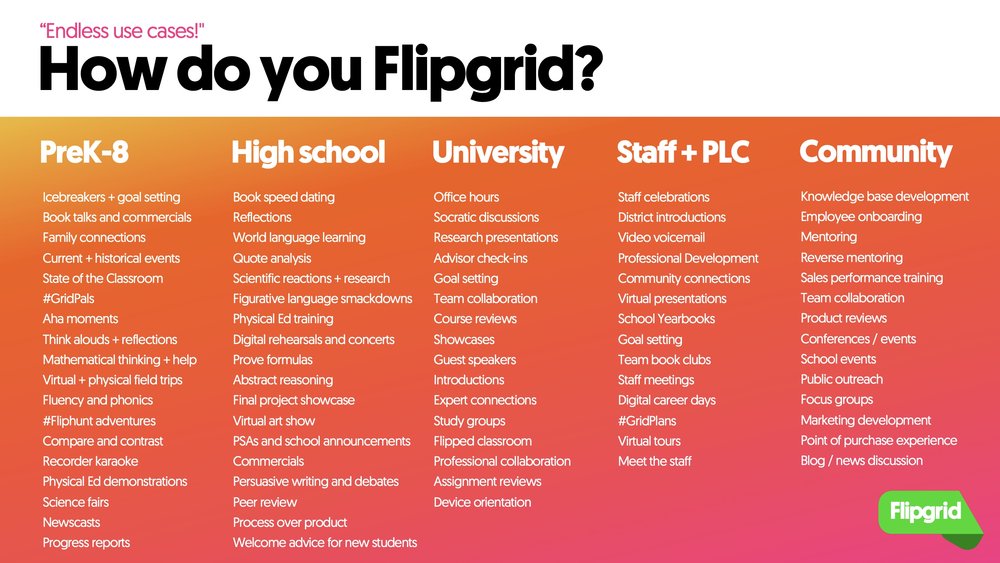
    For those that follow me on #Twitter, you know I have been spending my summer learning about Flipgrid.  For those that don't know, Flipgrid is a platform that allows educators to post questions to students and allows those students to respond via video to both the teacher and each other.

    Or at least on the most basic level, that is what it is. Truthfully there is far more power in this platform.  And that is what I have been learning over the summer - how to begin to incorporate Flipgrid into my classroom routines.  What has been wonderful is anytime I had a question, I could post it to #twitter and either someone in my #PLN or someone from Flipgrid itself would reply. In fact last night I wrote a direct message to Flipgrid about some settings and there was a reply to me within two hours!

    I decided to start to incorporate this into my remediation class. This year I am teaching a class that focuses on Executive Function Skills and then applies those skills to writing. The students in this class have difficulties with organization, planning, prioritizing, noticing details... the very skills you need for both writing and to be a successful student.


    On the first academic day of class, I gave the students a writing prompt: "You win $1 million. How do you spend the money?"  I told them I'd give them ten minutes and at the end of ten minutes they had to submit their response. They could not press 'post' until all 10 minutes were up and they weren't allowed to do anything else for those ten minutes.

    After 10 minutes, they posted their writings. I gathered them into one document and as a class we analyzed them - not for anything more than word count. I gave the class the data and after some math, students calculated that the average length of a response was about 20 words, so as a class they wrote just about 2 words per minute.

    We discussed the expected length of a 10 minute writing prompt as well as the outline.  At Marburn we use Keys to Literacy and talk about pre-writing as a major component of the writing process.  You can imagine the reactions: "Pre-writing doesn't work for me." "I just write my ideas and that's my sentences." "Why pre-write when I can just start writing!"  After some lessons about what pre-writing looks like, I introduced them to Flipgrid and told them we would be making a video to record their pre-writing. The prompt that day was, "What I did over the weekend."


    Students took to the video format pretty well. I explained they would have up to one minute of time to introduce themselves and talk about their weekend in as much detail as they could. Later that day I was able to watch each video and comment back to each of them a summary of their video, with notes organized by day.  The next class period, I explained they would have three to five minutes to turn my notes into organized thoughts. Students took these teacher-generated comments and turned them into a top-down web. From there they did a two-minute written response to the original question.

    What did they discover?  In those two minutes of writing, the average response was 32 words long meaning a student wrote an average of 16 words per minute.  One student was particularly stunned by the result: "So we wrote eight times more?" Yes - you wrote more words per minute AND more words overall even though you had 8 fewer minutes of 'writing' time. We talked about the amount of 'time on task' was exactly the same: 10 minutes. This broke down into 1 minute of a video, 3 minutes of summary (done by a teacher this time, with the knowledge that they would slowly add this skill in themselves), 4 minutes of building a top down web, and 2 minutes of writing.

    It was a powerful lesson and one that I was so glad to present. Many of these students have not had an opportunity to see the 'why' behind the pre-writing. This process, with Flipgrid adding some technological support, gave them the justification.  I'm so excited to continue to explore Flipgrid and the educational applications it could provide!


    Monday, September 2, 2019

    Support Systems


    This meme came across my feed recently. It's message has been rattling around my head the past week and I've really been reflecting on the meaning as it applies to my life. I am so blessed to have such a supportive system around me.


    This to me boiled down to these questions:  Who takes care of you?  Who do you allow into your life? How do you let them help you?

    For me the answer fell into many buckets:

    My family: I am blessed with an amazing family. My wife and I just celebrated the 24th anniversary of our first date. We just watched our older child start college and our younger one start 8th grade. We all have different goals and dreams, and we all support each other. I have some crazy ones: between my ultra running, my teaching schedule, and my American Sign Language class, so many hours of my week are consumed by non-family events.

    My wife and kids have similar craziness: work schedules, orchestra, college, my kid's home baking business... the list is exhaustive. It would be easy for everyone to say "sorry too busy" when one of us had a special event.

    But we don't. We make sure to sit down and have dinner most nights and family game nights a few times a month. We get to school events. We attend all of the children's concerts. There is never a question of "are we going" but more of a "what time do we have to be home to get there on time?"

    My school: I work at a school that encourages me to develop myself professionally. I really want to present more, and so the leaders of my school encouraged me to apply to present at AMLE 2019 for a third time. When we found out that my proposal was accepted, they celebrated as much as I did. When we discovered that the conference would happen the same week as our trip to Washington D.C, they looked for any way possible for me to attend. When that didn't work out, they said they expected me to present in 2020.

    The administration challenges me to improve my craft and lets me develop the leadership skills I want to evolve and expand. When I have an idea or observation, I'm comfortable bringing it to my team leaders.

    see you in Baltimore!

    My friends: There are so many people in this category. I have friends that can join me on a long run and process my school day or some activities I have in mind. I have friends that I can go out to dinner with to vent or chat. I have friends that enjoy game nights and friends that I can just talk to over instant messenger since they are no longer local. Some of them I've only known a year or so, and others I have known since I was in high school. I value all of them and hope I bring as much value to their lives as they do to mine.

    My #PLN: I can't count the number of times I have logged onto twitter with a question or idea and had replies within the hour. I don't understand why more teachers (or other professionals) do not take advantage of this resource. We build ideas on ideas, develop thoughts, and help share what worked for us. I'm launching my FlipGrid lessons this week SPECIFICALLY with feedback from people in my PLN. When I have a bad day, lesson, or idea, these people help me get back on track.

    As we are getting into the opening stretch of the school year, I'd encourage you to think about your support group and how they will make your year amazing.


    Tuesday, August 27, 2019

    Checking In: One week of relationship building.


    How is everyone doing with building those relationships?  We are one week into school now, so here are some of the activities we have done to start the year.

    At lunch today I went table by table.  I  said each student's name and if I didn't know it or remember it, I asked their name. It became a game with them, with many  of them hoping I'd get it wrong (some of them  got their wish...)  I'll head  to lunch again Thursday and quiz myself on the students that I missed.

    This is a great way to show them application of study skills: practice, get some wrong, focus on the ones you got wrong, practice again, repeat as necessary... keep practicing.

    In science  we practiced the art of "observation" vs. "inferences."  My co-teacher developed this idea for Social Studies and adapted it to Science.  It is pretty brilliant...

    Students were given envelopes filled with personal effects from my past. These included a train schedule, a class photo of me with my first students (dated sometime last century,)  some hockey cards, and a number of other items. These items were broken into four envelopes.

    What the heck is this thing?


    On top of these four envelopes, students also got to investigate two personal spaces: My desk and my car. Now, let me ask you. When was the last time you let students go through your desk? Would you let them?

    Here is what my students discovered: I like snacks. and tea. a lot. In fact one drawer was FULL of these things. They saw lots of Rubik's cubes and NASA items. They saw a $1 bill in my top drawer. There were pens, pencils, former students' work, and lots of chocolate. And yes, that $1 bill was still in my desk at the end of the activity.

    My car was less exciting, but they were all curious about my 'mascots.'  On my dashboard I have Pain & Panic (from Disney's Hercules), White Rabbit (from Alice in Wonderland), a small rubber duck, and a children's block.


    Ideally in the following days the students will have to build as much of my life story as they can: Where have I lived? Who is in my family? What are my hobbies? How far back in my life  can you go? Why can't you go back further? Can you finally figure out how old I am? Why did I chose to keep those things in the car?

    As the year progresses, we will connect this activity to many of the scientific concepts we will be studying: geological time scales, Earth's changing features, fault lines, and more.

    I hope everyone's first few days have been wonderful.  I'd love to hear how things are going!


    Saturday, August 17, 2019

    Getting Started On The Right Foot

    As I get ready to start my school year, I found myself reflecting on some of the skills and strategies that lead to a strong start.  Now, as you read them I know you'll think that since I'm writing it, I must be great at these skills. Hardly. These are the ones that I know are important for both short and long term success in a year, but many of them are ones I struggle with enacting.

    Now this list is in no way fully comprehensive. There are many thoughts I had that would be important, but for me these are the ones I need to remember to put into practice.  These are presented in no particular order.... except this one:

    LEARN YOUR STUDENT'S NAMES. 

    Nothing on this list can help you have a more successful start and finish to a year than this.  You will be asking your students to get out of their comfort zone on a very regular basis. They need to trust they will be safe. Nothing breaks that trust more than saying "hey... um... you." There are many layers to emotional safety, but none are higher than you knowing that child's name. "Hey you, the volleyball player that likes MCR" is really not as effective as "Hey, Sasha! What was the name of the band you were talking about last week?"

    Practice their names. Say them correctly; ask if you are unsure. Don't give them a nickname because "the name is too hard to say" or "too tricky to remember."  Challenge them to quiz you in the halls and at lunch. Give them a high five when you get it right. Give them a high five when they have to correct you.

    Learn. Their. Names.


    Establish procedures and protocols in your classroom.

    If you have particular ways to hand in work, check in assignments, enter the room, or ask to use the restroom, make sure they know them. Practice these in detail the first few days. Explain them as expectations, not as discussion points.  If the procedure is important to you, stop class when it isn't followed.

    Contact your families

    As early as you can in the year, contact the families of all of your students. Call, e-mail, send a letter home. Whatever works best for your situation. Let them know how happy you are that their child is in your room. Let them know how well they are adjusting to their new grade/classroom/school. Invite them to contact you should they have questions or concerns. That one call or e-mail makes trickier conversations later in the year go much easier.

    Schedule you time


    The school year is a marathon, not a sprint. You need aid stations to get through it. Whether time is spent reading (for pleasure, not professional development), hanging out with friends (and not talking about lessons or students), blogging (about things other than work), Netflix... whatever. Find time for non-work-anything activities. No e-mail, updating grade books, looking at student work, or focusing on lessons. Schedule 'you time' on your google calendar. Make it sacrosanct.


    Be kind to yourself 

    Give yourself some grace. We preach to students that mistakes are expected. We tell them it's ok to misunderstand directions. We encourage them to push their limit knowing they'll fall along the way. We tell them "you're just doing this for the first time, of course you'll make a mistake!" Well, this is the first time you're teaching this curriculum to these specific students. If it is ok for them to make mistakes, it's ok for you to make mistakes as well.

    Reflect

    But focus on the positives. Ask yourself, "What went well about my day?" before you get into, "what would I have changed?" SO often as educators we focus on the one group that didn't get the concept, the one student that caused a disruption, or the one part of the lesson that bombed. Start with positives. Then, anytime you reflect on a negative say, "yup, but (this) and (this) went well."


    There are many many more thoughts on my mind that could be on this list.  I'm curious what would you add? Leave a comment below about something that I missed that is on your essentials list!