Showing posts with label tlap. Show all posts

Sunday, February 5, 2017

Explore Like A Pirate: Pandemic Based Game!

Last week a dangerous infection was let loose in math. Nobody knows the source or the cure (well except the teachers, of course), but class has been on edge trying to solve the mystery.

Students walked in on Monday and saw they had a 1 in 5 chance of being infected. They had no idea what this meant, but they were told that by completing problems in class they could start to find clues as to who is infected and how to cure it.

One of my favorites. Why not put it into class?

It was interesting to watch because even though they figured out the theoretical number of students currently infected (four), most chose to work alone because they didn’t want to risk sitting by someone that was infected. This led to a great social studies connection about how fear creates walls.

Students worked on problems related to simple and compound probability and were told that they could draw 2 cards for every 5 problems they got correct (which allowed them to connect ratios from a previous unit.)  If the student draws a heart card, they would get some information about the game.  This allowed students to complete work at their own pace while still being engaged.  Work could be done at home optionally for draws the next morning.  I have never had more students do optional homework than that night.

The right column is very filled with names now.

On Friday I conferenced with students one-on-one while they took a formative assessment. The meeting gave me an opportunity to do many things. I asked them how they felt about the learning targets, how comfortable they were, where they needed to improve. I also informed them whether they were infected or not.  Students that were infected had two choices: They could work for the light side and try to discover a cure to help the class, or they can play the role of antagonist and join the dark side to spread the infection.

Tomorrow they will come into class with a list of actions on the board, some for the light side and some for the dark side.  Actions include trying to cure the disease, spread the disease, mutate the disease to make it stronger, or protect someone from becoming infected.

The Game ends when one of these things occur:

  • Everyone is cured (light side wins) 
  • 80% of the class is infected (dark side wins) 
  • Mr. Taylor or Mrs. Menker says “the game is over”

(that last option allows us to end the game should students lose sight of the objectives or forget rules about physical and emotional safety.)

Students will complete problems (this will be a general review of the term so far) and after each problem they will fill out a google form to choose one action. From there teachers will discern the outcome and let them know the result.

We’re right in the heart of the game and I have no idea how it will turn out. Will students unite to destroy the infection, or will darkness win? I’m excited to see what happens!


Monday, January 2, 2017

My 2017 Word: Risk

Risk is a scary word. It implies injuries. It implies danger. Risk implies failure. I have worked at Camp Mary Orton for a number of years and when I run groups there we always talk about risk. There is risk in everything you do. When groups are doing the ropes course I remind them while the course looks dangerous, they have done the most dangerous thing already that day - they drove to camp. Statistically there are more injuries on the road then there are on ropes courses.

My summer playground :) 

Risk is more though. Risk is about exploring, if not conquering the unknown. Risk is aiming for greatness, but not always succeeding.

There are a number of places I have not taken risks. I have a fiction novel that I wrote a number of years back. One copy sits printed on a shelf while the original sits in a cloud. I have a teaching book that I’ve been writing for years. It’s sitting safely in my mind. The risk of writing it and the steps beyond that are too great for me to comprehend.


Quoting one of your favorite authors after that paragraph? Ironic...

This is only one area of my life I have not taken a risk. I plan on taking risks on a number of fronts this year - physically, emotionally, mentally, and professionally. We are about to take off on this great adventure called 2017. I’m hoping to have a number of stops along the way:

  • Risk taking time for myself 
  • Risk being selfish 
  • Risk talking to authors and publishers 
  • Risk running more and further than I ever have before 
  • Risk implementing lessons that may not work 

Every great story starts with risk.  One of my favorite quotes is, “If you don’t risk anything, then you risk everything.” In fact it is the quote by my senior picture. My 2017 will be full of risk. I hope to see you along the way!

This pic will end up in my next kahoot :) 

Saturday, October 15, 2016

Who Killed Mr. Xavier Pression?

I just got back from AMLE 2016, and what an amazing experience.  I met some amazing people, including many that I've been talking to during #MSCHAT and #TLAP talks.  I know many of you want to hear all about it, but honestly this graphic kind of explains where I am currently at:

I think I need to install some new RAM.


So for now you'll have to read about my latest activity.  

This year my 7th grade math class has been immersed in a game world.  They are in guilds named after mathematicians (Kepler, Nother, Euler, and Brahmagupta), exploring a world, and helping to bring together two nations.  They were introduced to Mr. Xavier Pression, the main diplomat brokering the truce between the nations of Gunthar and Sancrist.  Last week they received a message that Mr. Pression has gone missing.  They completed a series of quests to find him, which all four guilds did successfully.  

Unfortunately at the end of the last quest they found this on the screen at the end of the period:

It took a minute, but they eventually got the pun.

There was shock on everyone's face.  He was dead? How could that be?  They did everything they could to find him.  The next morning they walked in determined to find his killer.  

I purchased this activity from Teachers Pay Teachers.  It is a clue-based activity to have students write algebraic sentences as expressions.  In fact the whole game is set up like the boardgame Clue.  Here is the link to the product - I highly recommend it: Who Killed Mr. X. Pression

Now here is where Dave Burgess would say it is time to kick it up a notch.  They could have just come in and done the activity. I could have had the worksheets with the clues out and they could have just completed them and discovered the person, place, and thing.  However, this was a murder mystery. This was drama.  This was a crime investigation.  So instead of coming in to a worksheet laden room, they came in to this:

SO much positive feedback about the atmosphere.


Dark room, chilling music, the only thing out was the title.  By the way, students were actually working when I shot this video - that's the murmuring you hear in the background.  There was so much excitement and chatter.  They wanted to finish this assignment.  They learned that their sponsors were offering rewards including kingdom points, renown points, and new items to anyone that correctly completes the problems and solves the mystery.  They begged to get it started. 

How often can you say that has happened while teaching writing algebraic expressions?  


Saturday, November 7, 2015

Where have you been? Mediocreing?

The problem (for me) with blogging is twofold:

a) not having anything to write about because
b) I have so much I WANT to write about.

It becomes an endless cycle of 'list topic, start blog, ohh squirrel!'

Then I realized something.  This is what happens with teaching as well.  By this point of the year we're all 'in our groove', first term (or so) is finished, and we're hitting the main stretch of the school year.

Of course by groove I mean not-being-able-to-get-into-a-rhythm-due-to-all-the-holidays-and-days-off.

It is really easy at this point of the year to just lean back on the culture and routines you've established and just coast through winter break.

"What's the point of getting this fantastic lessons ready when I have a 3 day week then a 4 day week then a 2 day week, then just about two weeks, then winter break? I mean the students are going to be so disengaged that I'll just do this easy lesson and it will basically do the same thing."

Fortunately for you, the amazing teacher inside of all of us is shouting at full lung capacity:

As teachers, we need have many responsibilities, but there are also things we are NOT responsible for doing.  We are not responsible for 'getting through material' with 'easy to create' lessons.  We are responsible for sparking life long learning.  We are not assigned to stuff knowledge into student's heads.  We are assigned for opening, and then blowing up, our students' minds (more on this on my next blog!) 

A big push in education is student engagement.  Are students asking questions? Are they showing grit?  Are they moving up Bloom's taxonomy? 

Here's my question: How can you expect your students to be engaged if the TEACHER isn't engaged?  

You are responsible for your students engagement, and it starts with you.  If you are creating safe lessons, lessons that don't excite you to teach, lessons that you are bored even thinking about, how can you expect your students be engaged to learn?

As Dave Burgess, author of Teach Like A Pirate says, "Safe lessons are a recipe for mediocrity at best."

And you did not wake up today to be mediocre.

Saturday, September 12, 2015

Gaining Perspective on a Geological Scale

Earth has been around a long time. I mean a really long time.  Some people think landing on the Moon or the invention of the digital watch was a long time ago, but Earth hasn't even blinked a metaphorical eye in that time.

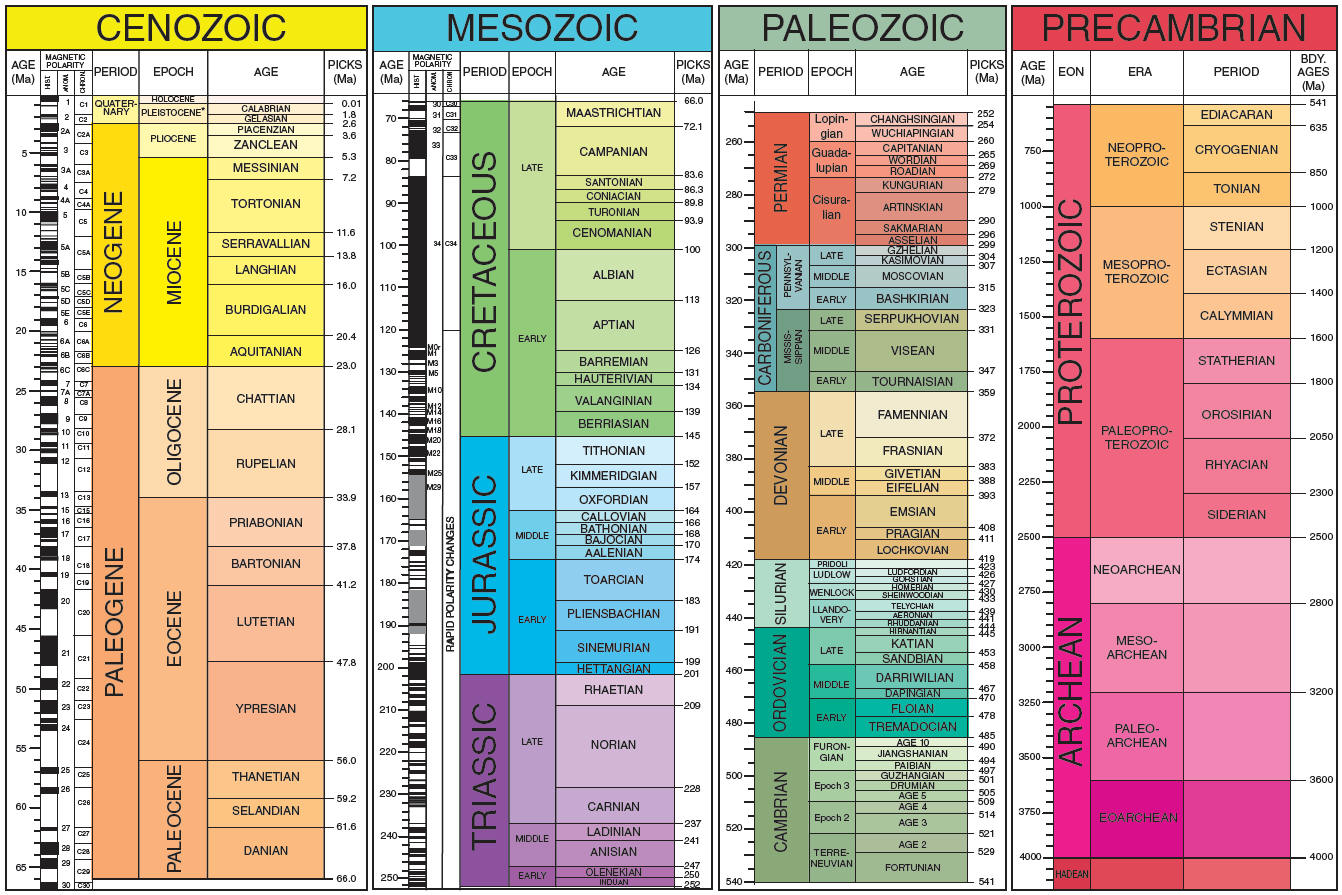
So the question is always how to explain to students what 4.6 billion years of history actually looks like.  Worksheets, articles, and videos all do a decent job, but this year I went a different route.  We started with students investigating various types of geological time words: Eon, era, period, epoch, ages.  We compared those to years, months, days, hours, minutes, and seconds.  Each word connects to a longer period of time and it is possible to say we're living in 2015 as well as saying it is September, or it 5:00 pm.

From there they investigated 4.6 billion years of history in one of three ways: an article, a brainpop video, or the geological timeline.  The goal wasn't to master any of the vocabulary or concepts, but just to get some familiarity with the material.

4.6 billion years of history in an itty bitty space

I ended the lesson by saying to get familiar with one of those three materials because our next session we're doing a lab... and I'm bringing in a time machine.

The next two days they did nothing but ask me about what I meant.  All I told them is "don't be absent otherwise you'll have to build your own time machine and go back in time to see mine!"

Amazingly, I had perfect attendance for my next class.

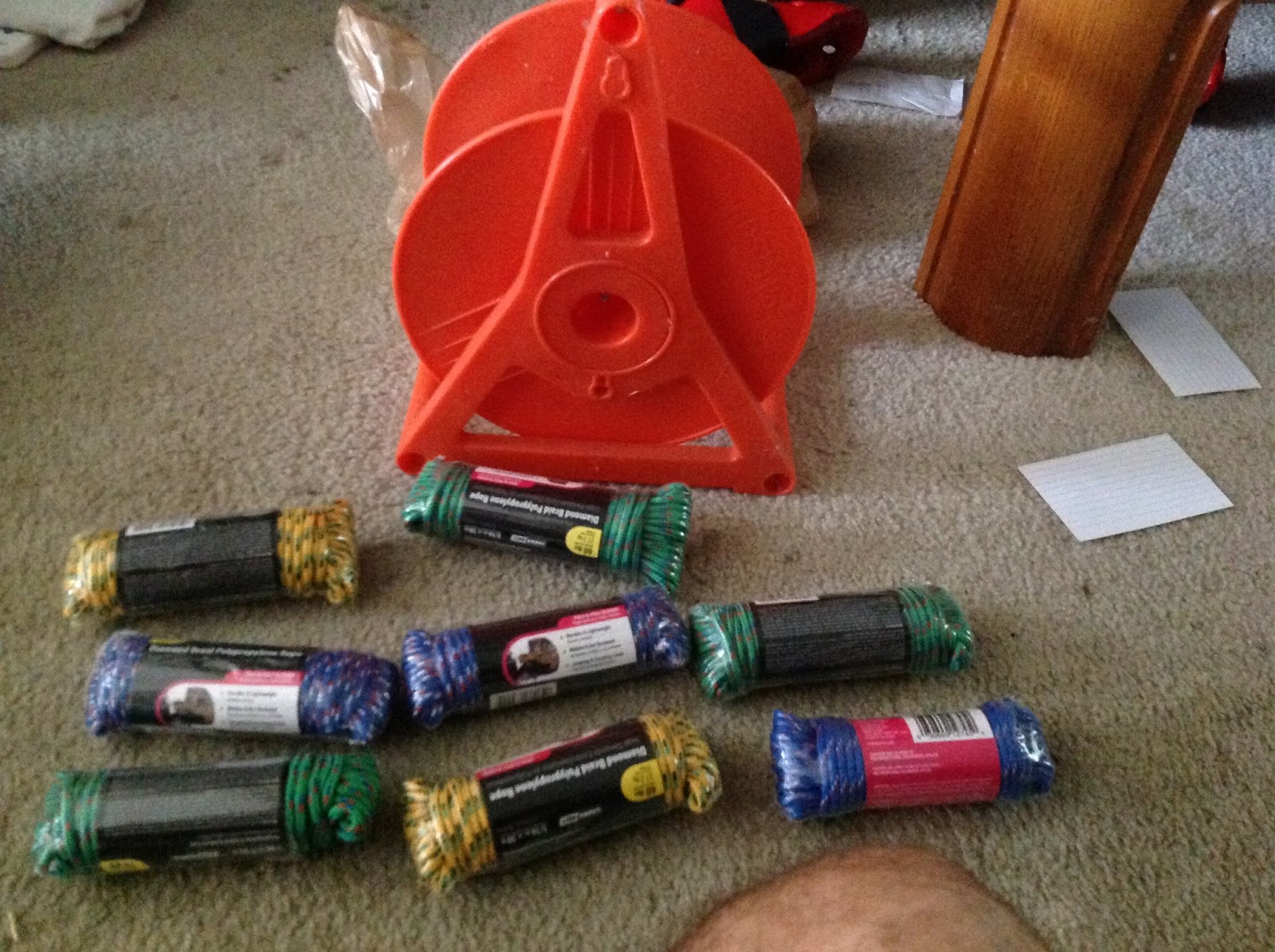
But first I had to build it.


When students arrived we did a quick entrance ticket on half life and then they got into their guilds to discuss what item they studied and what facts they remember.  Students started discussing many of the vocab words, concepts, and I had to make some clarifications, but overall there was a great supply of knowledge shared.

From there I said we would be going back in time 4.6 billion years.  Each group was given four flags with major events from the geological timeline: fish first appear, dinosaurs first appear, dinosaurs go extinct, humans first appear.   Their task was going to be to place the flag on the correct spot of the timeline.

My time machine was definitely a step down from a Delorean

The students went to the playground field and were told we would walk back in time.  As we did we'd see lots of historical events, but their job was to find the four they've been given.  I explained that there were many colors of rope, and that there was an orange piece of tape in the middle of each rope color.  I also gave them a paper with a scale on it: one foot = 12,000,000 years, color changes = 600,000,000 years, end of rope to tape = 300,000,000 years, and tape to tape = 600,000,000 years.

We walked the timeline back and ended 400 feet from the present day, reviewing the scale for the first few tape marks and color changes.  From there I gave them 15 minutes to debate and decide where their flag should go.  Each person was in charge of their own flag, so if there was a disagreement the owner of the flag had the final say.

Then I just let them go.  The debates and discussion was amazing.  Students cited evidence from their reading or video, used visual references from the time line they may have studied, and recalled their previous information to help build their hypothesis.  They were outside with nothing but their flag and their brains - no notes, no computer, just recall - but they were all actively engaged and using evidence. They also were working on disagreeing respectfully - a skill that we practiced the first few days while we were building our classroom culture.


Me standing in present day, my co-teacher about 1 billion years in the past, and dots of children at the birth of Earth.

After 15 minutes we had many different places of the flags.  We talked about which was easier: deciding the order or deciding the placements.  The students made the connections to relative and absolute age from previous lessons and were able to experience how much easier one is than the other.  When I asked how many flags their group put in the right place, all of them predicted zero. 


     Lots of debate on flag placement
 Different color flags represented different groups.

And it led to some fantastic debate

When time was up, students came back to the birth of Earth. I grabbed my meter wheel (top left photo) and we started walking the timeline together.  We examined sixteen major events, with the four they placed among 12 other key items.  

There were so many OMG moments and WHOA I DIDN'T REALIZE comments during the return to present time.  "Before we can have life, the Earth needed a crust... and that took... {walk walk walk} 15 meters, or about 600,000,000 years.  As we passed flags students picked them up to see how accurate they actually were.  

Below is the table I used as we walked the geological timeline.  


We did some processing in the field.  The biggest take away was how long it took for fish to appear.  When we returned to the classroom students completed a 3-2-1 exit ticket involving things they learned, whoa moments, and lingering questions.  Here are some of their responses:

"WHOA" moments:
I never realized how short of a time humans have been around! Dinosaurs were around for like 150 million years but humans have only be around for 2 million!

I knew that humans were the newest flag, but I didn't realize fish have been around for so long!

Life really just started on this planet compared to how old it is!

It took longer for the crust to form than when fish first formed to today!

When life started forming it happened fast! like we did almost the whole timeline before we hit fish but then it was like every meter we stopped!

and my favorite:

At one point algae was the highest form of life on this planet. 

What do you want for dinner? SUNLIGHT? MY FAVORITE!