Sunday, March 15, 2015

Welcome to the Math Art Gallery!

So we are closing in on that spring break, which of course means that because of this and the fact we just finished PARCC testing,  our students are all but checked out.  Perfect time to introduce geometry concepts, right?

Right.

Looking at the CCSS, I go through some of the key terms and words that my students will have to know to continue their mastery of learning targets.  A few are ones they have mastery of, some are ones that are familiar, but most are ones that will need some review.

On Wednesday, I start the lesson.  The students walk in and see a stack of white paper, compasses, and rulers.  They also notice bins of colored pencils and markers up front.

I begin the lesson explaining how hard they have been working and I really felt we needed a day to just relax.  No major lesson today - they will have the period to just draw.

An aura of suspicion goes up, but I continue:

Seriously, all I have planned today is for you to draw.

One brave soul speaks up - "Mr. Taylor, you have something up your sleeve."


OK, there are two conditions.  First, whatever you draw has to be school appropriate.  Second, you have to use these tools as intended for their regular use to draw.  You can not draw freehand at all.  I mean I need to add SOME element of challenge, right?

I then introduce the compass and explain how to use it.  I tell them there is some learning curve (hah) to it, and they will need some practice to build the muscle memory.

There is still some doubt in the room to the 'leniency' of the assignment, so again I emphasize the main points:

You can draw whatever you want as long as it is school appropriate and you must draw using the tools as designed (rulers for straight lines, compass for curves and circles.)   No freehand.

I then pass out the paper and tools.  I explain that each student gets exactly one sheet of paper - if they "mess up" they can use the back, but after that they have to incorporate errors into their art.

I give them the period, making sure students are using the tools correctly and helping them use the compass - in fact I end up setting up a mini-lesson station for this tool.  They are excited and work the period.  They ask about color, and I tell them there is no expectation of color, but if they choose to color that can be done by freehand so long as the original lines are visible.  They are also allowed to black outline by freehand (instead of re-using the tool to trace over an established line.)

Here are a few samples of what my students created:


 They ask about homework, and I tell them they can finish their products, remembering the rules.  Some students borrow compasses, others choose to hand in what they have.

The next day students come in and see their works of art hanging around the room.  I welcome them to the math art gallery and ask them to take their seats.

The girl that spoke up yesterday mentions, "I knew there would be more to this..."

I start by asking who has been to an art museum before.  Many students raise their hands.  We go over norms of art museums:

  • quiet voices
  • you aren't allowed to touch the art work (or even come close to it)
  • walk slowly
  • You shouldn't lean on the walls or use them to write on
  • Don't clog up any areas

I actually had this video prepared in case students were unfamiliar with the norms, but didn't have to use it:  How to behave in a gallery.

From there I welcome them again to the Math Art Gallery.  Their assignment is to find different forms of geometry in the various works of art in the room.  They should take notes as to who's artwork it is in and where in the artwork they see it.

I also tell them there is a definition sheet in two different spots of the room - if they are unsure about a term, they should reference that sheet for help.

They then take the next thirty minutes in the art gallery looking for the terms, but also admiring each other's work.  I wander the gallery with the same worksheet, finding the same properties.  They complement each other as they pass, and I share some of my favorite observations. We all comment on properties that are easier or harder to find.  Some, we note, are quite rare!  Students also remind each other of the norms as they walk.

I really enjoyed that part of the community building - an unexpected and happy outcome :)

After thirty minutes, we all return back to our spaces and review our work.  Students share where they found the terms - scalene triangles, trapezoids, arcs, chords, and so on.  As we review, students become shocked at how many geometric terms are in their drawing - they are amazed that there is so much to their work.  Specifically, the student that did the 3d cube was amazed at what was found.  He said he just wanted to do a simple shape, but it turns out that he and other students found the following elements in his drawing:

  • acute angles 
  • cube
  • obtuse angles 
  • parallelogram 
  • parallel lines 
  • perpendicular lines 
  • rectangle
  • right angles 
  • right triangle 
  • rotational symmetry 
  • scalene triangle 
  • squares
  • trapezoids

Over a dozen terms in that one 'simple' design.  They began to build awareness of geometric terms and properties in everyday objects around them, looking at them through a new lens.  From there students began attaching meaning to the vocabulary.  They gained practice using the tools to create more specific designs.  Their natural curiosity kept the momentum going, and all of this coming the week before spring break.

So for those of you closing in on a week off - keep the lessons real, make the time count, stay away from the worksheets, and keep the students enchanted.


This was my contribution to the gallery.

Sunday, March 1, 2015

Meet My New Baby, Neon!

I have a new baby!  I adopted one of the elements last night!

Confused? Want to know more?  So did so many of my students - and that is the beauty of using hooks when you teach.  Students want more information - they crave it.  It's torture to NOT give them knowledge.

Here is how a typical science lesson can go:

Teacher - "OK, we've been studying about elements.  We know how to arrange the electrons in the first twenty elements pretty well, and I'm pretty sure you know how to calculate the number of protons, neutrons, and electrons, so now you will all become an expert on one element.  You'll have to pick an element and do research on it.  You need to find out the key components of that element - the ones we have been talking about: melting and boiling points, period, group, as well as some interesting facts about the element.  Be sure to also include a Bohr's model.  You'll put everything on a poster and present it on Monday. I'll give you some class time today to get started."

The teacher is giving the information, telling the students what they know, and letting them know what the expectations are.  Picture what the students are doing while this information is being disseminated.  Are they focused? Are they interested? Are they engaged?  Are they looking interesting  facts up before you even tell them to do so?

Would you want to be in this classroom?

Most students in this classroom tuned out by the word "research."  Nobody is engaged, unless they have a strong internal desire to learn about the properties of elements.  The teacher is assuming knowledge that may or may not be there.  And the poor elements are literally all around them - in the air, the paper, the drool on the desk from the student that fell asleep -  thinking, "Is this what we've become? How drab!"

(Drab is elemental for "boring and non-pirate-esque")

In the book Teach Like A Pirate by Dave Burgess, you get dozens of great hook ideas, ways to transform lessons, and a chance to reflect on your pedagogy within the classroom.  I always felt I was a pirate-type teacher, but his presentation at The Association for Middle Level Educators really tied it together for me.

Here is how my science lesson looked:

First, as the students came into the classroom they saw me in the back of the room around a small doll bed.  I look down at the bed, smile, say I've gotta go teach now, cover up something in the bed, and head to the front of the room.

Props - one of the keys to teaching like a pirate!

I load up Kahoot and we review concepts presented in the past  couple of weeks.  I get some great formative feedback, including the fact that my students need more practice calculating the number of neutrons in an element, but I'm really happy with how well students have internalized the learning objectives.

A girl named Lauren was the winner, pulling ahead on the final question, and got to do her victory lap dance around the classroom as we applauded.

This was the final question that gave her the win. There were massive protests.

The students - now fully engaged in the class - are told a bit about my evening.  I got approval to adopt a new baby.  His name is Neon and he's gorgeous - a beautiful orange red baby!  I show them the adoption papers and explain that the adoption agency allowed me to let students also adopt elements that weigh between 3 and 20 AMUs.  

Students are directed to their notebooks.  They look at what elements this might include.  They connect that these are the first 20 elements except for Hydrogen and Helium.  My class is only 16 students, so I tell them that each baby element can only be adopted once.  I also told them I'm not giving up my baby, so Neon is also out!

We then use instant classroom to hold a 'draft' as to which element they get to adopt.  After a student makes a selection, I give them their new 'baby' - with artwork designed by Kacie D.  

From there I shared both my example adoption paper as well as a template for them to create their own paper.  Students already had links to resources to complete the assignment.  I explained that adoption papers were due by Monday.  It didn't matter - many of the students wanted to get started right then.  

Now, this lesson wasn't without issues.  Upon reflection, I didn't do as well as I could have during the 'draft' portion.  Students were choosing elements that they knew other students wanted, and at times were laughing at how some of the elements looked.  I did address this the next day, but  I could have done a much better job of community building by addressing these issues immediately. 

However, this lesson got every student EXCITED to have a deeper understanding of one specific element.   Students were asking if there was a limit to how many fun facts they could research - can they do their own art work - could you make a bigger poster?   Teaching like a pirate changes student engagement WITHOUT changing content.  In fact the content tends to go deeper and becomes more intrinsic because of the thrill that comes with the learning.

Teaching like a pirate transforms your classroom - what pirate stories do you have?  How do you hook your students?

Saturday, February 21, 2015

Ready for the Real World Yet?

This week I've been privileged to be part of two wonderful twitter chats.  The first was on Teachers Throwing out Grades (#TTOG) and the second was Middle School Chat ( #mschat.)

Being the time of year it is, the conversations revolved around testing: is it good for students and/or for districts? Does it give good information? How should we prepare students for tests?

During the chats, I got into discussions with two different people, both passionate educators as well, and I'm sure both very good at their job.  Both conversations came back to two central themes.

First was the theme of competition in the classroom.  I am a competitive person.  I play team sports to this day.  I was in little league way before the whole 'everyone gets a trophy' mantra.  I have run track, played hockey, coached and played soccer, and even was on the high school bowling team.  I find value in competition both in building character as well as a tool for building relationships.  There is definitely places for competition in schools - I just don't believe learning is one of those places.

This is not a philosophy for a classroom setting

Education is not and should not be competition.   Learning is not a zero sum (or negative sum) game.  There should not be 'winners' and 'losers'.  If one student succeeds, it shouldn't mean another can not or did not.   Your success shouldn't be based on others' failures.

Those that know me know that I am not a fluffy, cuddly teacher.  I don't give out candy for right answers.  I have a high level of expectations and demand students reach them.  However, I do it with a blanket of emotional safety.  They quickly learn that saying a wrong answer in class will never cause a problem, but laughing at someone for saying a wrong answer will.  We play games in our room, often competitive ones, but the end game is not to find out 'who is the smartest.'  It is to find out 'what do you know?'


My philosophy doesn't revolve around the belief that all students can learn - I have the expectation that all students will learn - and it is my job to make sure it happens.

And there lies the antithesis of the zero-sum philosophy.  Everyone can get an A.  If you don't do an assignment correctly the first time, you have to reflect on what went wrong, re-learn the material, and have another go at it.  Assignments are not one-and-done.  This is how I get them ready for life.

This leads to the other major theme: getting students ready 'for the real world.'  There is competition in real life.  However, in nearly any real life situation the competitor chooses to compete.  Athletes choose to be on a team, employees choose to compete for a higher position.  Students have no choice to compete in the classroom if that is the culture the teacher creates.

True, not all competitors have a choice.

The other situation school needs to get them ready for are real world tests.  They need to have this awareness.  Telling them that they will have to take tests to get a license, get into college, or even qualify for certain jobs and careers is a good thing.  However, I know of no entrance test that is completed over the course of six two-hour periods. I know of no test or assessment that prevents applicants from re-taking it should they not pass the first time.  And yet we put a 12-year-old child through a multi-day test one-shot assessments which could extend two hours (or more with the right IEP accommodations) and under the premise of getting them ready for 'real world' situations?

Are any of these 'real world' skills? Do you want your employee to possess any of them?

Treating a 12-year-old student with the same (or even similar) expectations we have of a 22 year old college graduate, or a 16-year-old young adult,  is not only poor pedagogy, it is downright unjust.

Also , we can't hide behind 'school gets children ready for the real world' and then excuse ourselves out of it when it suits us; never in the "real world" have I ever

  • gotten a detention for chewing gum
  • had to raise my hand to go to the bathroom
  • gotten in trouble for doodling during a meeting


Maybe I'm just not in the real world yet.  

Those are my thoughts - slightly more rant style than I usually blog, but there it is none the less.  I'm hoping to hear from others - with any view points.  I truly value hearing all the arguments. No two schools or classrooms are the same - it takes all types of teachers - and I'm glad there are a diverse pool out there!

Tuesday, February 10, 2015

Time to put a round fish through a square triangle.

Here we are yet again!  It's February, which of course means a month of "Get ready for that oh-so-important-standardized-test!"  Classrooms all across the nation are sending home 'test prep' and adjusting schedules to help 'bubble students' succeed.  Here in Ohio we have the honor of breaking out a brand new version of this ritual: the PARCC Assessment.

PARCC, for those that don't know, stands for the Partnership for Assessment of Readiness for College and Careers.

Wait - a test that assesses readiness for college and careers?  Finally something that will decide if my students will have a successful life!


This week I was part of a fantastic twitter chat on #tlap which revolved around the topic "What is Smart."  How do you define smart?  What is intelligence?  Are there smarts besides 'book smart?'  So many fantastic ideas were shared and I really got to focus on my own thinking on this word "smart."

Go ahead and google search the images for smart kids.  See anything?  What about smart student? Notice any patterns? Not that google is the expert in 'smart' but you sure better know higher level calculus to qualify as a smart person.

Ironically "smart teacher" put you at elementary school math.

Like Google, I'm hardly an end-all expert on the topic either, but I really feel the word "smart" is an antiquated term.  There are so many aspects of "smart" in today's world.

Being a College and Career focus test, I assumed this is the type of thing that employers would want to see students ace.  After all, employers want smart students to build their smart work force, and this test is designed on college and career readiness.

But what do employers mean by smart?  Ask around.  Generally employers want people that have the ability to come up with a proposal, organize it, and then execute the plan.  They want people that can solve problems with the resources available to them, or think "outside the box" to make more options feasible.  They want people that can make common sense decisions and persevere through the day-to-day challenges that any work place encounters.  And they want people that can ask intelligent questions.  Questions that help the company or organization move forward and stay at the forefront of their sector.  

On top of intelligence, they are looking for people with integrity.  People that can be trusted to handle large sums of money, be left alone with someone that may be vulnerable, or to close a sale.  

Looking over those skills, how many are measured on a typical standardized test?  Of course the PARCC isn't a typical test - it's a college and career readiness test!   And to see how ready your child is for college it comes complete with questions such as:

The average distance from Earth to the Moon is approximately 384,400,000 meters. What is the average distance, in kilometers, from Earth to the Moon written in scientific notation? 
(actual practice test question available from The PARCC resource page)


That is a real practice multiple choice question from the real practice 8th grade math exam.  Look at the skills it involves:  First - can you write in scientific notation (a clear math skill), but also can you figure the TRICK of "hey we changed units in the middle of a problem just because we could - AND we put the change in a small prepositional phrase in the middle of the sentence, even though no math person in their right mind would EVER change units in the middle of a problem let alone in the middle of a sentence!"  

Unless, that is, your future profession is proofreading.
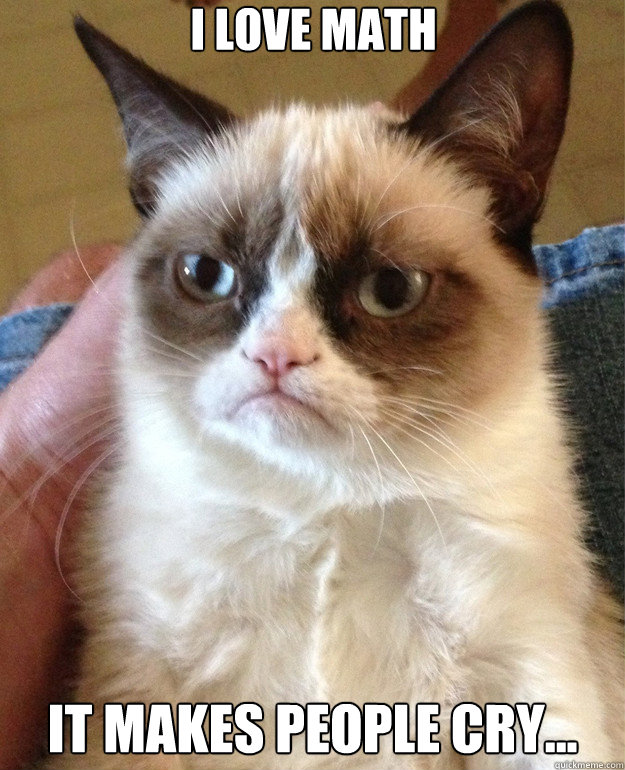
Also, what's up with all the cat memes this week?

As teachers want innovative, creative, dynamic, curious children. We want courageous students that are able to take risks. We want children that help each other and use all the resources available to them. We want them to have skills such as communication and a growth mindset. We tell them that these are the skills needed to succeed in today's world.

And then we sit them in rows and columns and give them a standardized test because... yeah...

So, to my students and my own two children... I am sorry.  You will see these test questions and you may cry.  Literally cry.  Other teachers reading this probably are thinking of students that will as well.  You aren't alone.  Just remember, this test doesn't define how "smart" you are.  You have plenty of ways to show that off.  We see them. We brag about them.  Hopefully we're letting you know this every day.

Good luck on your exams. Your teachers are preparing you as well as they can.   Go into the tests with an attitude.  Send THEM home screaming and crying.  Then, when they are done, continue being the amazing human you truly are.  Our future is counting on it.


Saturday, January 31, 2015

Today I will read your future minds...

A few weeks ago my math class started algebra concepts.   I have a fantastic lesson that I spiced up thanks from some advice from Dave Burgess and his excellent seminar on how to Teach Like a Pirate.    Students sit down, get out their notebook, look up and read the board.  However, instead of the usual warm up or friendly message, they see :  "Today I will read your future mind!"

They giggle as usual, and taunt my talents.  I play along - "Oh, doubters... just wait.  You don't even know what you are thinking yet... but I do...."

With that I take out an index card and turn my back to the class.  I look over my shoulder a few times, making sure to have direct eye contact with a few of them.   As I'm turned I write a message on the index card.  I put this index card into an envelope, seal it, walk up to one student very deliberately, and put it into the student's binder, folder, or book, warning all of them not to even touch the envelope.  I then explain how soon they will all write what I have just written on this card.

Hook?  Check.

I then lead them through the typical pick-a-number scheme where you add, multiply, and do all this magic to the number.   I encourage them to choose a lower number as there is some arithmetic to do to this number, but really any number will work.  No calculators are allowed and students must show their work for each step.

Here is the algorithm I lead them through.  I haven't tried reading minds over the realm of the internet, but I'm willing to have a go.  All of you readers, math geeks and non, should play along.  I'm curious if I can use my psychic powers through wifi.  Here are the steps I give my students:

  • No talking from here out - it disrupts the psychic energy.
    • pick a number 
    • double that number
    • add 4 to the result
    • triple that result 
    • subtract 6 
    • divide by 6 
    • add 4 
    • subtract the original number from this result (this step usually takes some clarifying)
    • circle this final answer
    Now I want you to look at this chart.  Find the letter that corresponds to the final answer circled on your paper and write that letter on your paper.

    For instance, if you got a 8, you'd choose 'h'

    I always make sure to walk around the room to see what number is circled and to clarify this step.  I also help students that may have made a mistake in arithmetic.

    Once everyone has their letter I stop and build the drama a bit more.  I close my eyes - pretend to meditate... whatever. Get a good psychic vibe in that room!

    When I continue I ask them to think of an animal that starts with the letter they have written down and have them write this animal in their notebook (telling them specifically that spelling doesn't count.)  For example, a student that gets an 8 could write 'hyena'.

    I then ask them to think of a color that animal can be, and to write that as well.  For instance, if they got an 8 they might choose a brown hyena, but can't pick a pink hyena.

    At this point I walk back to the student that has the envelope.  I look at the answer in their notebook and smile.  I ask them if they think I have the same thing written on the card in the envelope.  They always hesitate.  The anticipation is thrilling.  I ask that student to open the envelope and to read out loud what is written.

    Most of the time they don't even read it out loud.  Most of the time they shout out "NO WAY!"  Generally what happens from there is the rest of the class reacts with shock and awe with a hint of fear.  Eventually the card gets read.  Students are in disbelief.  How is this possible?  Will you teach me?  PLEASE? TELL ME YOUR SECRET (seriously - students begging to be taught?)  Nobody can believe that I have done the impossible.  Same color. Same animal... well, 95% of the time.

    If you are playing along you might wonder what is on in that envelope and if I've read your mind through the world of cyberspace.

    You may wonder, if in fact, I will end this post with the words grey elephant.  

    I think I will.

    Next time I'm using one of these as a prop.

    Sunday, January 25, 2015

    Are you feeling lucky, punk?


    Hello, World!  As promised I have the second part of my protocol outlined below.  This review game is based on the one presented last week, Card Sharks. I use this version in bigger groups, usually 16 or more, though this game plays well for classes of 12 students and larger.

    Title: Higher / Lower

    Quick Summary: Students will review various skills and practice probability.

    Materials needed: A 20-sided die

    Prep: Review questions for the class

    Procedure: 
    see: Card sharks - The procedure is identical :)

    How to "Play the Board"

    Initially you need to set up a row for each group:

    We will have 5 groups in this game

    We talk about the die and that it has the numbers ranging from one to 20 on it.  My class is very used to this die by now, but the initial time you play every single student that hasn't seen one of these will want to play with it... And the students that are familiar with it will instantly ask you if you are a gamer.

    yes... yes I am.

    From there groups that earned the right to play the board get to choose if the next roll of the die will be higher or lower than a 10.  I then write in an arrow to confirm their choice.  I generally give them a few seconds to collaborate, so they all have to call the same answer.

    I forgot to take that photo - so here is one with ms paint arrows instead :)

    Groups that are correct get to play on; groups that are wrong lose all of their progress.  There are a few differences between this and the card version:


    • I don't allow them to change their number after they freeze - I have found that this takes too much time away from the academic time in larger groups. 
    • Each group plays the same roll (rather than having their own row of cards).  This means there could be different base numbers for each group.
    Play continues with groups reviewing concepts, predicting higher or lower, debating the next, and freezing when they feel they should stop.


    After a while the board starts filling up nicely:

    In this game, group one was doing well, but went for it all and missed!

    When the game continues from this point, Group 4 would be guessing higher or lower than a 9, while groups 3 and 5 would be predicting from a base of 13, group two would have a base of 2 and group 1 would start with their 10.   I put the arrows on their next space, then roll.

    Remember: not every group is guaranteed a play each turn!

    The groups get very into this game and start talking strategy early.  They keep each other accountable for doing the review work since they do not know which member of the group will be "randomly" checked during that phase.

    I love this game because of it's versatility.  You can play it in any subject for any topic.  I've used it for science, math, and language.  Specifically, this lesson involved writing FANBOYS and aaawwubbis sentences using correct punctuation.  I'd love to hear how things go in your room when you try it out!  Comment below!


    Monday, January 19, 2015

    Another Review Game, 80s game show style!

    I hope everyone had an amazing winter break.  Things have been crazy here in Columbus - with Ohio State winning the first National Football College Championship and all.   That story actually has been a great anchor for teaching about growth vs fixed mindsets due to all the injuries that OSU had to endure, the changes the staff and team had to make, and the success they still earned.

    This week I'm presenting a highly engaging review game that my students love playing.  It is 100% based on the 1980s game show "Card Sharks" featuring Bob Eubanks.


    If you never experienced the 80s, this video will answer lots of questions...
    ... if you did experience the 80s, this video will give you bad flashbacks.
    skip to 4:50 if you just want to see how the game is played :)

    In this game students work as a team to review concepts taught.  This protocol is 100% adaptable for any age group or subject, and needs minimal preparation.

    I have two versions of this game: one for smaller groups of sixteen or less that uses a standard deck of cards, and one for groups of more than twelve that uses a 20 sided die (twelve to sixteen students can effectively use either version.)  I'll be outlining the card version today and the dice version next week.

    Title: Higher / Lower (or card sharks)

    Quick Summary: Students will review various skills and practice probability

    Materials needed: A deck of cards

    Prep: Review questions for the class

    Procedure:
    1) Divide the students into small groups

    2) Students take out their notebook.

    3) Teacher puts a review problem on the board.

    4) Students solve the problem as a team, completing work in their own notebook.  They may, of course, help their teammates.  During this time I'm usually walking the room monitoring behavior, tone (keying in on competitive students that may not be patient with others), and giving subtle hints.  I'm also usually reminding students they can only write in their own notebook.

    5) Teacher chooses a random person from each group and checks that person's work, noting which groups got a correct or incorrect answer.

    6) Review the answer as a class - any group that got a correct answer gets to play the board (see below.)  All students that got an incorrect answer should copy the correct procedure, making note of their errors, even if the group got a correct answer.

    It is important during the review time that all students understand that even if most of the group gets a correct answer, you are only checking on one random person per group.  This builds concurrent engagement and accountability.  I'll roll a die to 'decide' the student I'm looking at.  Naturally I'm looking at everyone's work and making notes on my clipboard, but the illusion of picking a random student is there :)

    How to "Play the board"

    For smaller classes I set up a row of cards for each team.  I'll put six to eight cards in a row depending on how long I want the game to last.

    The game is afoot!

    Groups that have correct answers get to decide if the next card is higher or lower.  It is important to establish the order of the cards.  I write the card values from low to high on the front board so students have a visual of this number line.  If they are correct they can continue and risk their gains, or 'freeze' and guarantee their safety.  An incorrect answer knocks them back to the previous freeze point or the start if there was no freeze point.

    I turn the card sideways to signify 'freeze'

    The other groups then gets an opportunity to play (assuming that they had the correct answer to the review problem.)  In this version I play classic "card shark game show" style in the sense that players can choose to keep the frozen card or change it for the top card in the deck.  

    I find this game provides lots of excitement, is a great review of probability (there was so much discussion on whether you should 'go for it' with a nine showing), and gets students imbedded into the review lesson.  

    And of course it leads to situations that you couldn't really predict...


    The 9 changes ... to a QUEEN!
    "LOWER!"
    Lower than a queen - A FOUR!
    "HIGHER!" 
    Higher than a four... another four... 
    "Is ... that.. wait... NOOOOO!!!!!!"

    Next week I will include how I've use this game with classes as big as forty-plus students!  I'll also be back later this week with a bonus blog (to make up for the one that I missed!)