Saturday, January 14, 2017

The Importance of Routine

Many of you know I’m in the middle of marathon training. Last week I almost missed a speed run. It wasn’t because of injury or family reasons. It was because I couldn’t find my Garmin watch. Instead of following my routine of putting it back on the charging station, I put it… well somewhere else. I searched for that thing for nearly 40 minutes, even enlisting my daughters to help, but no luck.

I still went on my run, using my cell phone and a couple of apps to help time my splits, but knew that this mistake could cost me serious money. Luckily my wife ended up finding it… in the pocket of a sweater that was lying on my bed. Not following my routine ended up costing me time and raised my anxiety.

#MyLife

Routines are important for students as well. Well run classrooms thrive on routine. They build muscle memory, allow students to feel comfortable and confident in the classroom, lower anxiety, and uncertainty, and give teachers the full allotment of classroom learning time.

That isn’t to say teachers can’t be spontaneous, but basic routines as far as what to do when entering the classroom, sharpening pencils, or handing in homework are essential.

Over winter break our school moved into a brand new building. We went from a one-floor, two hallway school to a 64,000 square foot, 2-floor, multi-hallway building. Despite it being January, my teaching partner and I treated Monday and Tuesday as if it were the first day of school – no academics, no tests, all routines and procedures.

My new home away from home

Students came in the first day and we talked about their winter break, what they did, and gave students some time just to be middle school chatter boxes. We went over schedules, took a tour of the building as a class, and gave them a classroom scavenger hunt. They had to sharpen pencils, hand in assignments written on index cards, sign out to use the water fountain, and even staple papers together.

Our classroom also has two standing desks and six wiggle stools which students can use instead of standard chairs. We reviewed procedures and expectations of how to move to standing tables or how to get a wiggle stool. Students then practiced doing this.

These are amazing! I use them in staff meeting now.

By taking time and actively teaching the expectations in the new space we let students reflect on their anxieties in the new building and determine how to best adjust to the new space. On Wednesday students handed in assignments quickly and efficiently, moved furniture around the classroom without disturbing other students, and felt they had ownership of a classroom. By Friday students were fully confident in coming into classrooms and following procedures, leaving plenty of time for education to happen.

Even with a full mooned Friday the 13th.
(yes I know the full moon was the 12th and it was technically waining gibbous the 13th. I also know the century started in 2001 not 2000.  But sometimes pretending is fun.)

Monday, January 2, 2017

My 2017 Word: Risk

Risk is a scary word. It implies injuries. It implies danger. Risk implies failure. I have worked at Camp Mary Orton for a number of years and when I run groups there we always talk about risk. There is risk in everything you do. When groups are doing the ropes course I remind them while the course looks dangerous, they have done the most dangerous thing already that day - they drove to camp. Statistically there are more injuries on the road then there are on ropes courses.

My summer playground :) 

Risk is more though. Risk is about exploring, if not conquering the unknown. Risk is aiming for greatness, but not always succeeding.

There are a number of places I have not taken risks. I have a fiction novel that I wrote a number of years back. One copy sits printed on a shelf while the original sits in a cloud. I have a teaching book that I’ve been writing for years. It’s sitting safely in my mind. The risk of writing it and the steps beyond that are too great for me to comprehend.


Quoting one of your favorite authors after that paragraph? Ironic...

This is only one area of my life I have not taken a risk. I plan on taking risks on a number of fronts this year - physically, emotionally, mentally, and professionally. We are about to take off on this great adventure called 2017. I’m hoping to have a number of stops along the way:

  • Risk taking time for myself 
  • Risk being selfish 
  • Risk talking to authors and publishers 
  • Risk running more and further than I ever have before 
  • Risk implementing lessons that may not work 

Every great story starts with risk.  One of my favorite quotes is, “If you don’t risk anything, then you risk everything.” In fact it is the quote by my senior picture. My 2017 will be full of risk. I hope to see you along the way!

This pic will end up in my next kahoot :) 

Thursday, December 29, 2016

Reflections on 2016, Part II: Running

People kept telling me that I ran a lot this year. Like a lot a lot. Upon reflecting, it is probably an accurate statement. I completed 16 different events this year: Rocks and Roots 10k, Brokeman’s Winter Warm up half marathon, Rocks and Roots 20k, Possum 30k, The ORRRC Xenia ½ marathon, Glass City Toledo Marathon, ORRRC Tie Dye 32 miler, Columbus Zoo 5k, Brokemans Wild Things 4 miler, Not Your Momma’s 50 km, Running with Scissors double marathon, Hot Chocolate 15km, New Albany 4 miler, Run Santa Run 5k, Big Foot 10 miler, and the Yeti Run.

They were all my favorite. Especially Yeti. 

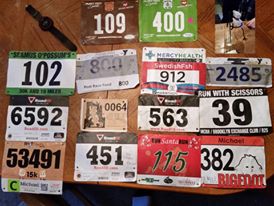
Looking at that list I’m pretty much in awe - It was about 3 years ago that I ran my second half marathon and swore I would never run that distance again. It was just over a year ago I finished my first marathon. I found a picture of my 2014 bibs (EDIT: it was actually my bibs from 2013 AND 2014) on facebook and in the comments section I was ecstatic that it had four 5k bibs, a 10k bib and 2 half marathon bibs. Now I have run a marathon distance or more six different times (four of those times in 2016.)

Not Yo Momma's 50k - the most difficult 50k I've run to date.

Oddly enough I became friends with Erika in 2014. Pure coincidence I’m sure. Sidenote, Erika is running the Pistol Ultra 100 miler on New Years eve/day - so proud of her! You can read about her adventure here.

Still, the year was not ‘perfect.’ I had two did not finish results (DNF) this year: The first was at the January Rocks and Roots which was supposed to be a 20k but due to the fact I could not feel my feet (literally) after the first 10k, I chose to stop. The second was the Scissors double marathon where I “only” ran moved forward 41.1 (66km) of the 52.4 miles. You can read more about that here. 

I still gave myself a present.

However, I also fell in love with pacing this year, leading the 11 minute pace group during the Columbus Hot Chocolate 15k. It was great helping people achieve their goals since so many people had helped me achieve mine over the past year. Case in point, I ended the year with my fastest 5k ever thanks to my great friends Becky and Erika. It would have been an even faster time if I could have kept up with them past mile 2.5.

All in all I have logged over 1360 miles (about 2200 km) of running this year. For some perspective, that is about the distance from Cleveland to Denver. Looking forward, I have a number of activities and events in 2017. So far I have at least three half marathons, one full marathon, and two 50 kilometer runs on my calendar by the first week of June. Yes I said at least.

Here we go again.

A big thank you to all of my friends and family that supported me with encouragement, candy, a sarcastic comment, or all of the above. My wife and two daughters are just brilliant.  They push me, encourage me, cheer me on, and fully support me in all of this.  I truly would not be able to do this without them.

I love all of my running buddies and I'm proud of every mile we logged together! I will need all of your support, encouragement, and more in the coming weeks!

I’m looking to share many more miles and stories with all of you in 2017!

Happy Running :)

Tuesday, December 27, 2016

Reflections on 2016, Part I: Teaching

Sorry I have been gone - about a month ago I decided to take a break from blogging. There were so many things coming up - our school was moving, holidays were coming up, and then when I was going to get back into it we had a death in my family. Blogging became the item that fell off my plate as I just didn’t feel up to the task.

Since then I’ve done quite a bit of reflecting. I have a two-part blog coming up: one for teaching and one on my running. Today we focus on the teaching!

I had two goals for the first half of my 2016-17 school year: Integrate cross-curricular lessons into as many of my own lessons as I could and gamify my seventh grade math classroom.

I’m really happy how well I’ve done with that first goal. Working with my co-teacher I have managed to put both language arts and social studies into my science lessons. During math we have talked about how math has evolved through time, how Romans used math, and how Rome fell because they didn’t have the number zero in their system. More directly, I tied my rates and ratios unit to maps for scaling and we were able to integrate lots of the social studies standards into the math curriculum.


Riots erupt when plebeians use exact change and see a balance due.


I also got to focus on argumentative writing in math to help language arts. Shelby introduced me to Which One Doesn't Belong at AMLE 2016. This became a focus in my class as it hit MANY of the Standards of Mathematical Practices. Students had to choose an item and write to defend why their answer was correct. From there they had to write counter-arguments as well.

Of course we also went to the math art gallery!

My second goal took on a life of its own. Students fell in love with the gamification process. They were in guilds which competed to help save Mathemagicland. Classes had individual and group awards, followed the leader board, and were rewarded with spells and items which gave advantages to their group. What I really loved is that some students found pretty wicked combinations with the game cards - ones that I didn’t see until they put them into play!

You never know if you are light or dark side until you play a game.

My gamification took a break the same time my blogging did, but the students are excited to return to Mathemagicland in January.

I had a number of other highlights throughout the first half of the school year, but my biggest was going to and presenting at the AMLE 2016 National conference in Austin, Texas. While there I met so many amazing educators. These people are not only passionate about education, but also about middle grades. It was wonderful putting a face and having a meal with people I have interacted with over twitter for the past year or more. I got to watch these people present their knowledge, and many of the ideas I saw I am using in my classrooms now! I’m proud to say that a number of them came to see me present as well (despite the fact I was in the same time slot as educational gurus such as Dru Tomlin, Dave Burgess, and Rick Wormeli.)

Apparently Rick was nervous about me. 

I’m excited to get back to school in January. For those that don’t know, we’re moving into a new building (as in newly built) in January. We have taken a few tours of the building, but have yet to see the space with amenities such as furniture, paint, or in some cases, walls.

I also promise to be back blogging and sharing some of my great and not-so-great ideas in 2017. I hope everyone is having a relaxing and recharging holiday break. Look for my running recap blog on Thursday!

Sunday, October 30, 2016

Celebrating My Failure


As most of you know, I've become a pretty avid runner.  About four months ago I signed up for a double marathon (52.4 miles.)    When I first signed up for this event, pretty much everyone asked one question: Why???? (usually with expletives.) I joked about the rabbit hole of running, the peer pressure, or just because I was bored, but the real reason was a bit different. 

As a classroom teacher I ask my students to push themselves in so many ways - they have to do work they don't want to do, set short and long term goals, attempt subjects they don't enjoy and/or are not intrinsically good at learning... basically they are forced to get out of their comfort zone. I decided making them do this without being willing to do it myself was not the message I wanted to send them. I had signed up for marathons and 50 km runs (31 miles) and completed them before. These were definitely NOT in my comfort zone, but since I had successfully completed them I felt I needed to step it up further.  So on June 30th I registered for the Run With Scissors double marathon.

Yes, you get scissors 

I started the day with a 3 am wake up call. Ironically I actually woke up a bit before my alarm -not uncommon considering how excited I was about today. I left my airbnb with a great note from my hosts Kevin and Carolyn hanging on the front door wishing me luck. Arriving at Cuyahoga National Park at about 3:40 am, I got my gear ready, set up my drop bag, and at 4 in the morning I started off on my first of two 26 mile laps. I'll spare you the mile-by-mile play by play -  the first 15 miles were great, but I was definitely feeling the distance by mile 23.  I finished lap one in about six-and-a-half hours.  

At the start/finish aid station I changed my shirt, socks, and got some food.  I wasn't feeling optimal, but I still went off for lap two. Things didn't improve much from there. Physically I felt fine - my nutrition was where it needed to be, nothing was cramping, hydration was solid... but my body was just not responding well. Come mile 30 I was walking way more than I was running. I was having serious discussions with my body: 

"OK, this part is slightly down hill and seems like a beautiful time to run!"
"Nope!"
"But it ..."
"NOPE!"

I did feel better than this guy. 

I arrived at an aid station at mile 36 and had to sit down for nearly 5 minutes. The crew there was AMAZING - they asked me questions, gave me suggestions, provided aid, and really motivated me to keep going.

After leaving that station I had to follow a five mile loop before I returned back to that same aid station. It was during this loop I realized I was not going to finish this run. I needed to average about 18 minute miles during the last half marathon of the run and I was nowhere near that, coming in closer to 22 minutes per mile. My legs just did not want to go anymore. After some really tough reflection I decided I was going to drop when I returned to the aid station. This would give me about 41 total miles.  I slowed down and really started to enjoy the run - taking pictures and admiring the sights and sounds. It took nearly 2 hours for me to get those 5 miles done.


Gorgeous scenery! 

By the time I got back to the aid station it was 3 in the afternoon and I'd been moving for 11 hours. The crew there was once again amazing. They celebrated my success as did I. They took care of me wonderfully and gave me a ride back to the start/finish line. My run was over about 11 miles short of the finish. 

My goal was to get out of my comfort zone and really push to see what my body could do. I learned that my limit for today was about 41 miles. There are dozens and dozens of possible reasons that I topped out there today. Maybe it won't be my limit next time, but that's not for me to decide now.

It is also a great reminder to all of us to celebrate successes even when goals are not reached.  Celebrate the student that gets a 55% on a quiz, a student that gets one out of ten free throws, or just the student that came to school that day.  For them, this might be their own personal success.

We're still not really talking to each other...

Saturday, October 15, 2016

Who Killed Mr. Xavier Pression?

I just got back from AMLE 2016, and what an amazing experience.  I met some amazing people, including many that I've been talking to during #MSCHAT and #TLAP talks.  I know many of you want to hear all about it, but honestly this graphic kind of explains where I am currently at:

I think I need to install some new RAM.


So for now you'll have to read about my latest activity.  

This year my 7th grade math class has been immersed in a game world.  They are in guilds named after mathematicians (Kepler, Nother, Euler, and Brahmagupta), exploring a world, and helping to bring together two nations.  They were introduced to Mr. Xavier Pression, the main diplomat brokering the truce between the nations of Gunthar and Sancrist.  Last week they received a message that Mr. Pression has gone missing.  They completed a series of quests to find him, which all four guilds did successfully.  

Unfortunately at the end of the last quest they found this on the screen at the end of the period:

It took a minute, but they eventually got the pun.

There was shock on everyone's face.  He was dead? How could that be?  They did everything they could to find him.  The next morning they walked in determined to find his killer.  

I purchased this activity from Teachers Pay Teachers.  It is a clue-based activity to have students write algebraic sentences as expressions.  In fact the whole game is set up like the boardgame Clue.  Here is the link to the product - I highly recommend it: Who Killed Mr. X. Pression

Now here is where Dave Burgess would say it is time to kick it up a notch.  They could have just come in and done the activity. I could have had the worksheets with the clues out and they could have just completed them and discovered the person, place, and thing.  However, this was a murder mystery. This was drama.  This was a crime investigation.  So instead of coming in to a worksheet laden room, they came in to this:

SO much positive feedback about the atmosphere.


Dark room, chilling music, the only thing out was the title.  By the way, students were actually working when I shot this video - that's the murmuring you hear in the background.  There was so much excitement and chatter.  They wanted to finish this assignment.  They learned that their sponsors were offering rewards including kingdom points, renown points, and new items to anyone that correctly completes the problems and solves the mystery.  They begged to get it started. 

How often can you say that has happened while teaching writing algebraic expressions?  


Saturday, October 8, 2016

It's So EASY When You Put It That Way


My 6th grade math class isn't as ready to be fully entrenched in the #gamification, but we still play plenty of games.  We just don't do the leaderboard, experience, or player character aspects - there are no NPCs (Non-player characters), and they don't collect items.

I haven't ruled out doing this later in the year, however.  In fact I have penciled in a quest where the 7th graders have to rely on sixth graders for important information.

Today I introduced the concept of combining integers.  Amazingly, I did it with a game.  Shocking, I know.   Students logged on to an interactive number line maker (there are many, I used this one) and let students play around for a bit.  After they became comfortable using the page I instructed them to create a number line from -20 to 20 that counted by ones.  I then had them move their circles to zero.

Students were organized into teams and they saw that I had spread out a deck of cards on the front table.  I explained that I removed the face cards from this deck, and so that the card values of two through ten were available.

I then explained the rules of the game.  Each student would be chosen, one at a time, to pick a face card.  Black cards represented positive numbers and red cards represented negative numbers.  We reviewed that positive numbers were on the right and negative were to the left.  They quickly made the connection that if they pick a black card, the number would move right, and a red card would move them left.

The first team to positive 20 points wins the game.

Students came up one at a time, picking their team's starting card.  From there they moved their virtual number line to their starting place.  As more cards were picked students realized black cards were always good and red cards were always bad (in this game anyway. I hinted in a future game they may want the negative cards!)

What they didn't realize is they were learning how to add integers.  I specifically instructed them to not use words like "adding" and "subtracting."   Later in the week when I introduced the vocabulary and concept, they were blown away how easy adding integers was.  We talked about how this was addition (even though negative cards "subtracted" the value" because we were always adding cards to their collection.  Later in the week I gave students a check-out (formative) assignment and nearly the whole class scored 85% or higher.

When I get back from AMLE 2016, I plan on introducing subtracting integers with a similar game - students will start with cards and get to discard to get to a target number.

I'm off to Austin tomorrow for AMLE!  'll be arriving on Sunday and my session, Building Simultaneous Engagement, will be on Wednesday at 11:30 am!  Hope to see many of you there!