Monday, September 28, 2015

#tweet your learning

Processing is one of the most important aspects of learning, and yet is often one of the most overlooked areas of education.  Students need time to reflect on what they have learned, have time to digest new information, and connect it to previously learned material.  Reflection ensures students are fully engaged and making meaning of the material - producers and not just consumers.

Over the next few blogs, I am going to talk about some of my favorite processing tools in the classroom.  These activities allow students to actively internalize information, have them use different cognitive skills during the activity, and have an element of fun or interaction which I also enjoy.

The first activity is "tweet" your learning.  I am not yet at a point where students have active twitter accounts (though I'm working on this!)  However, using a subpage on classtools.net called Twister, students create a tweet to tell me one important fact they learned from the day.

I love this exercise for many reasons.  Students can only give one 'tweet',  and so they only get 140 characters.  They have to be precise with their vocabulary and word choice. They start reflecting on 'what did I learn' and 'how can I summarize this so succinctly.'  Students are actively forced to use different types and levels of metacognition.

When students get to the site they have four fields to complete: name, nickname, tweet, and date.

On the surface, students can write their name their 'nickname' and give a tweet  and a date.  So, in theory a final product could look like this:

This tweet would definitely meet the expectations.  It told me one fact and even had some of the vocabulary we discussed.  While this is all great, one of my favorite aspects of this site is that it comes pre-populated with different images.  If you type a popular name into the real name field, it will use that person's (or creature's) picture in the tweet.  I showed this example to the students:


This tweet also shows comprehension of new concepts, but does so from a different perspective.  The tweet itself shows a dino misinterpreting those darn kids with the actual object in the sky.  The date, 65 million BC, matches the researched date of when the extinction level event occurred.

They then download the tweet as a .pdf and then upload the file into our digital dropbox.

The students really enjoyed this and don't realize how much thinking they are doing.  I got so many wonderful responses.  Here are a couple of student examples:


What would you tweet about what you learned today?  Who would you use as your avatar?

Tuesday, September 22, 2015

26 days - 26 donors for 26 miles

In 26 days I'll be completing my first ever 26 mile run.  I have one more long run, 20 miles, before I start falling back in preparation for the Marathon.

I've been reflecting on the past six months.  The emotions I've experienced over that time have been nothing short of overwhelming.  I've gone from someone that couldn't believe he was running 15 miles in a week to running more than that in a day.  My monthly mileage has increased from about 40 miles to over 120 miles.


Much like my training, when I hit a goal I've celebrated then thought about my next goal.  Eight miles became 10, then 12 and eventually 20.  I've constantly increased my running goal after reaching that goal.   Back in April, when I launched my fundraising page, my goal was $750.  I knew of a few people that would donate and figured that was a great 'stretch' goal.  I was amazed how quickly people supported my cause, hitting that first goal in the middle of May.  I then set goals for $1000, $1200, and $1400, and with the help of so many caring people I reached them all.

So here is my newest goal:  I would love to have 26 new donors in the next 26 days.  It is by far my most ambitious fundraising goal, but considering the growth I've made in six months I feel it is a reachable challenge.  However, much like the support I've gotten from my family and friends, I can't do it alone.


Here is how you can help:

a) Donate if you haven't done so yet.  Every dollar counts.  Donating $1 buys a pair of anti-slip socks for patients. $10 buys 5 boxes of child-friendly bandaids.  $25 buys 5 packs of diapers for premature babies.  All of the funds go to help a child and their family.

b) Share my link.  If you know of people that would love to support this cause, tell them.  About 25% of the people that have donated to my cause are people I had never met before.  It is amazing what humans will do for each other.


You can make a donation by clicking on this link.

If you prefer donating by check, or would like to share my message via paper, you can click here to get a mail in donation form.

I am so grateful for all of you that have donated so far.  Nearly four dozen people have made a financial commitment to my run and Nationwide Children's Hospital.  Some of you are friends, some family, and some of you are people I have never met.  I am so blessed to have so much support in my life.  Thank you to all of you.


Saturday, September 12, 2015

Gaining Perspective on a Geological Scale

Earth has been around a long time. I mean a really long time.  Some people think landing on the Moon or the invention of the digital watch was a long time ago, but Earth hasn't even blinked a metaphorical eye in that time.

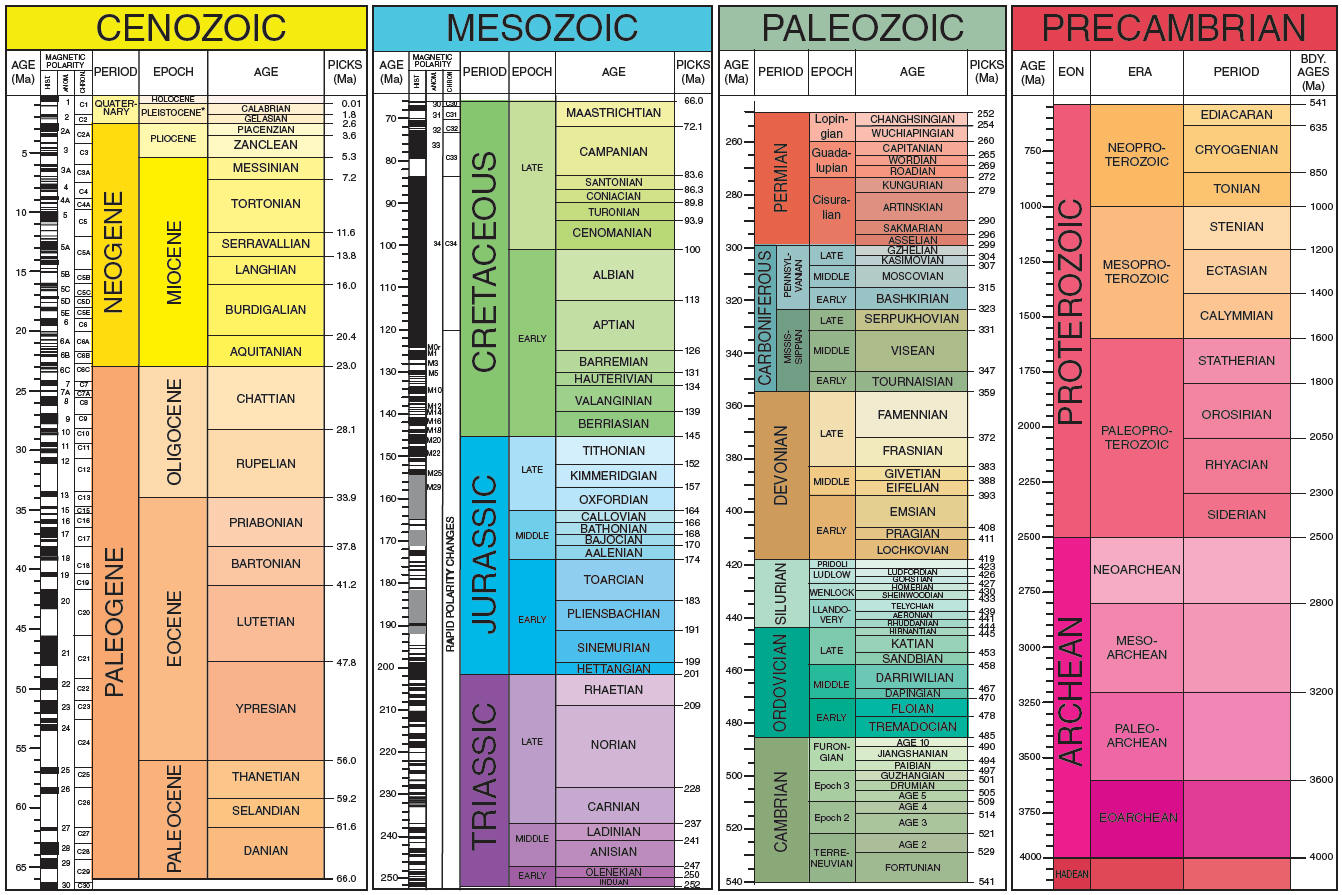
So the question is always how to explain to students what 4.6 billion years of history actually looks like.  Worksheets, articles, and videos all do a decent job, but this year I went a different route.  We started with students investigating various types of geological time words: Eon, era, period, epoch, ages.  We compared those to years, months, days, hours, minutes, and seconds.  Each word connects to a longer period of time and it is possible to say we're living in 2015 as well as saying it is September, or it 5:00 pm.

From there they investigated 4.6 billion years of history in one of three ways: an article, a brainpop video, or the geological timeline.  The goal wasn't to master any of the vocabulary or concepts, but just to get some familiarity with the material.

4.6 billion years of history in an itty bitty space

I ended the lesson by saying to get familiar with one of those three materials because our next session we're doing a lab... and I'm bringing in a time machine.

The next two days they did nothing but ask me about what I meant.  All I told them is "don't be absent otherwise you'll have to build your own time machine and go back in time to see mine!"

Amazingly, I had perfect attendance for my next class.

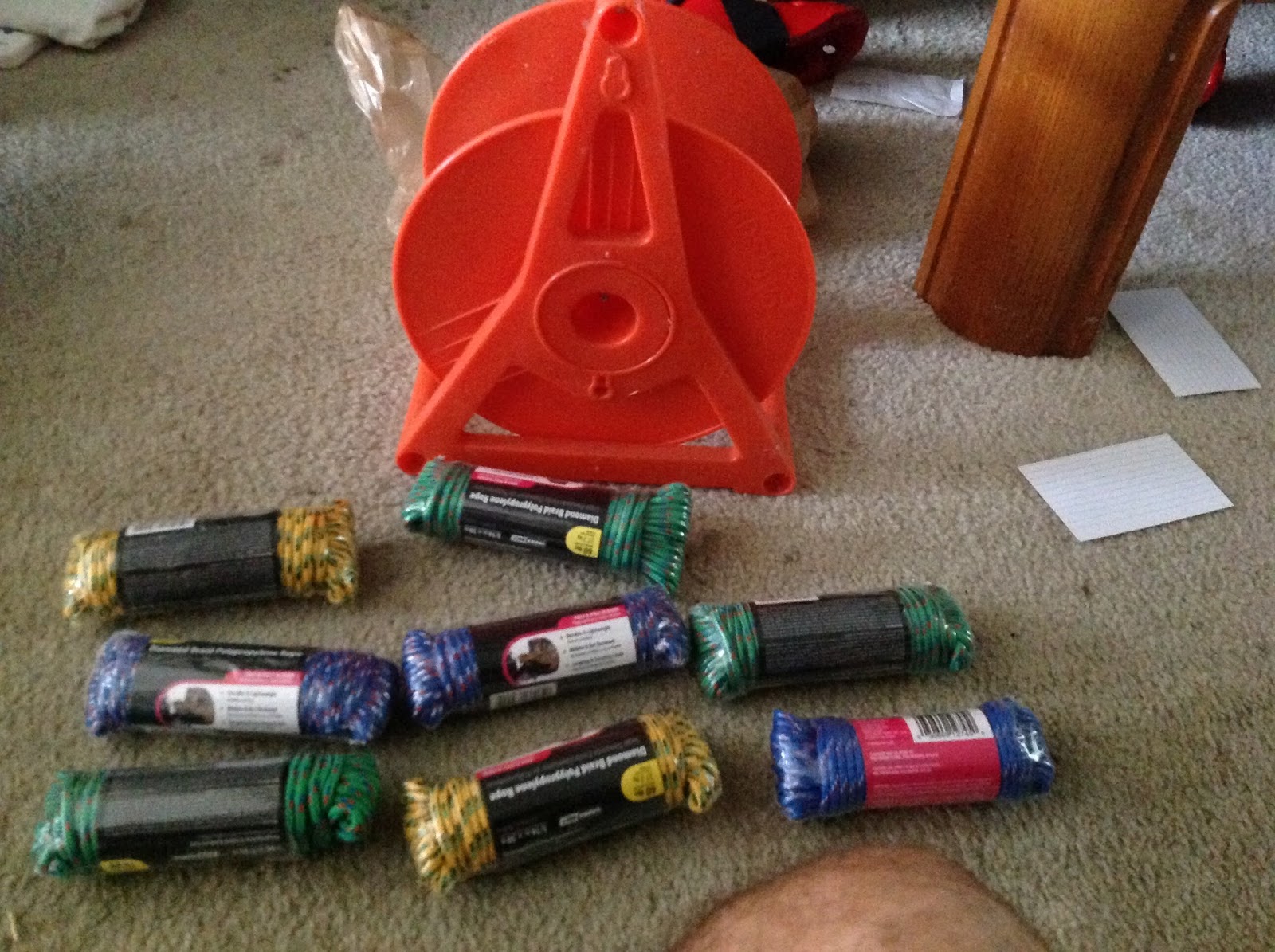
But first I had to build it.


When students arrived we did a quick entrance ticket on half life and then they got into their guilds to discuss what item they studied and what facts they remember.  Students started discussing many of the vocab words, concepts, and I had to make some clarifications, but overall there was a great supply of knowledge shared.

From there I said we would be going back in time 4.6 billion years.  Each group was given four flags with major events from the geological timeline: fish first appear, dinosaurs first appear, dinosaurs go extinct, humans first appear.   Their task was going to be to place the flag on the correct spot of the timeline.

My time machine was definitely a step down from a Delorean

The students went to the playground field and were told we would walk back in time.  As we did we'd see lots of historical events, but their job was to find the four they've been given.  I explained that there were many colors of rope, and that there was an orange piece of tape in the middle of each rope color.  I also gave them a paper with a scale on it: one foot = 12,000,000 years, color changes = 600,000,000 years, end of rope to tape = 300,000,000 years, and tape to tape = 600,000,000 years.

We walked the timeline back and ended 400 feet from the present day, reviewing the scale for the first few tape marks and color changes.  From there I gave them 15 minutes to debate and decide where their flag should go.  Each person was in charge of their own flag, so if there was a disagreement the owner of the flag had the final say.

Then I just let them go.  The debates and discussion was amazing.  Students cited evidence from their reading or video, used visual references from the time line they may have studied, and recalled their previous information to help build their hypothesis.  They were outside with nothing but their flag and their brains - no notes, no computer, just recall - but they were all actively engaged and using evidence. They also were working on disagreeing respectfully - a skill that we practiced the first few days while we were building our classroom culture.


Me standing in present day, my co-teacher about 1 billion years in the past, and dots of children at the birth of Earth.

After 15 minutes we had many different places of the flags.  We talked about which was easier: deciding the order or deciding the placements.  The students made the connections to relative and absolute age from previous lessons and were able to experience how much easier one is than the other.  When I asked how many flags their group put in the right place, all of them predicted zero. 


     Lots of debate on flag placement
 Different color flags represented different groups.

And it led to some fantastic debate

When time was up, students came back to the birth of Earth. I grabbed my meter wheel (top left photo) and we started walking the timeline together.  We examined sixteen major events, with the four they placed among 12 other key items.  

There were so many OMG moments and WHOA I DIDN'T REALIZE comments during the return to present time.  "Before we can have life, the Earth needed a crust... and that took... {walk walk walk} 15 meters, or about 600,000,000 years.  As we passed flags students picked them up to see how accurate they actually were.  

Below is the table I used as we walked the geological timeline.  


We did some processing in the field.  The biggest take away was how long it took for fish to appear.  When we returned to the classroom students completed a 3-2-1 exit ticket involving things they learned, whoa moments, and lingering questions.  Here are some of their responses:

"WHOA" moments:
I never realized how short of a time humans have been around! Dinosaurs were around for like 150 million years but humans have only be around for 2 million!

I knew that humans were the newest flag, but I didn't realize fish have been around for so long!

Life really just started on this planet compared to how old it is!

It took longer for the crust to form than when fish first formed to today!

When life started forming it happened fast! like we did almost the whole timeline before we hit fish but then it was like every meter we stopped!

and my favorite:

At one point algae was the highest form of life on this planet. 

What do you want for dinner? SUNLIGHT? MY FAVORITE!


Sunday, August 30, 2015

Front Loading the Gaming Experience

I hope everyone is having a great first week back (or is getting ready for an amazing first week back!) We've had a great start to the school year here in Central Ohio.  The weather has been amazingly mild (which is fantastic since I'm training for my first marathon), student attendance has been near 100%, and the gamification of my classroom is well underway!

Are you building excitement in your classroom? Are students dying to be called on in your class? If you are having trouble with this, read on!

We started our year with many of the team building activities I outlined in my past few blogs.  It really helped students and teachers learn names, set up a classroom culture of focused fun, and allowed students to get back into the routines of school after a summer off.  It was so nice to not even touch academics until the fourth day of school!

I also show my math class this video.  It is an amazing four minutes during which so many students, especially female students,  make incredible connections to the speaker.  It also destroys various stereotypes about 'math people.'
  • "She's a math major? She looks like she'd be in fashion."  
  • "That's so true - I always compare myself to everyone else!"
  • "I never thought of it as being at different places." 
For math class at Marburn, we start with pre-assessments which have students check out on basic facts for all four major operations, as well as whole number, fraction, and decimal computations.  As a class we have decided to do an operation a day and follow it up with a mini game.

objective: don't die!

We talked about how math is like a video game.  Students had to face 'speed boss levels' for their 2 minute timed fact test and then take on 'mini-boss challenge' for their operations.  You'll get a challenge, and sometimes you'll beat the boss level.  When that happens you get to go on to more challenging levels where you use the skills you've learned to take down stronger boss levels.

If you don't defeat the boss, you get new items and techniques to be better prepared the next time you reach that end level!  Most of the students attached to this quite well.

Many have enjoyed the paradigm switch from "I didn't do well on the assessment" to "I need more power ups before I'm ready to beat that boss level."

I've also enjoyed impressing my new math teaching partner with my ability to turn any game into a classroom activity.

"Hey, Erika, we're going to play Clue today in math."
"Clue... in math? Can't wait to see it!"

Students came into class while some mystery music is playing.  They saw their names on the board in groups of two with the instruction of 'sit next to your partner.'

But what if my partner is the killer?

From there I went through the procedure that is outlined below, making sure to keep the drama going strong throughout.

Game: Clue
Materials needed: Clue (cards and suspect sheets), white boards and markers (or notebooks)
Prep: Powerpoint of various math problems

Procedure: Put students into groups of two or three.  One person is the first 'writer'.  Each group receives a clue card of suspects, weapons, and location, a mini whiteboard, a marker, and a high tech white board eraser (a tissue.)

Each group also gets a set of 'clue' cards based on how many groups.  The game has 21 cards, 3 of which are removed as the confidential 'answer.'  The other 18 cards are divided up among the groups.  This may mean that some groups get more initial clues than others, for example 6 groups would have 3 cards for each group, whereas 7 groups would have 2 or 3 cards per group.

Students should take a moment to mark off the clues they have been given.  After that, they should leave their clues face down where anyone in the room would be able to access them.  I generally have them 'fan' out their cards on their desk.

Put the first math problem on the board.  Students work as a team to get the correct answer, but ONLY THE WRITER may write on the whiteboard.  Other students can help, guide, and suggest, but the writer is in control.  This also means if there is a disagreement about an answer or procedure, the writer gets the final say.


After an appropriate amount of time, have the students hold up their white boards. Any students that have a correct answer will have a chance to gain more information.  The writer passes the white board to their partner (or the next student if there is more than two in a group) and stands up.  They take one of their clue cards and can walk to any other group and trade.  They put their card face down and take any of the other group's face down cards. I have a specific procedure for this to minimize arguments and issues:

     a) trading round all happens at the same time
     b) once you touch a card, that is the card you take
     c) you have 15 seconds to trade

During the trade period, writers that had correct answers may trade with ANY other group, whether or not that group got a correct answer.

We do this is 'slow motion' the first couple of times to get used to the movement.

From there the new writer takes over for the group, a new question is posted and the procedure is repeated.

As the game continues, some groups may get close to solving the mystery.  If a group thinks they have the correct answer I have them circle their guess, but the game continues without them announcing their accusation.  If time runs out, groups circle their accusaton on their answer card.

I generally then give out the homework and announcements, and really build the anticipation of the contents of the confidential envelope.

I also give any correct investigators this certificate with all of their names on it.  I generally wait until all classes have played and list all the winners on one certificate.  I also post the certificate outside of the classrooms.


As they get used to the game, I change the cards to ones that have a bit more personality - I'll use teachers from the school as suspects, rooms from the school, and school items (staplers, scissors) as weapons.  This really gets them even further immersed into the gaming experience.

I love the engagement that this game naturally builds.  Students start to develop strategies such as trying to track who might have the cards they need to see, convincing other groups that they want to trade with them, and discussing answers to ensure they can gain new information.  The anticipation and excitement builds as more clues get revealed.  I've also added variations to this game so that if a group can explain their reasoning they get a 'double trade' (trade two cards instead of one.)  You will NEVER see students SO EXCITED to WANT to get called on as when you say "this question can earn a double trade."

I hope some of you try out this game in your room.  If you do PLEASE let me know how it goes and what variations you use! I love hearing different 'mods' in the game world!

Saturday, August 15, 2015

Team Building Parts 4 & 5 - Two more games!

First off, thank you for the wonderful feedback, everyone!  I really love getting e-mails, twitter comments, and messages on facebook about how the protocols and ideas I'm presenting are impacting how you approach games,  facilitation, and processing to start the school year.

One quick point I'd like to make based on a couple of comments I've received: I STRONGLY encourage you to use these protocols with your staff, team members, or friends before trying it with students.  First, it makes the struggle more authentic when you have experienced the same frustrations.  Also, it makes it much easier to facilitate and process the activity when you have an idea of what directions the game may head.

And of course, they really are fun to play!

Today I present two more games designed to help build culture during the first few days of school.

Protocol: Me, You, Left, Right

Materials: None

Procedure: Have students stand in a circle with you in the center.  Explain that the person in the center will point to someone and say one of four words: Me, you, left, or right.


  • If the person in the center says "me", the person that is being pointed at has to say the name of the  person in the center.
  • If the person in the center says "you", the person that is being pointed at has to say his/her own name.
  • If the person in the center says "left", the person that is being pointed at has to say the name of the person to his/her left (which is the center person's right).
  • If the person in the center says "right", the person that is being pointed at has to say the name of the person to his/her right (which is the center person's left).
Play continues until someone being pointed at doesn't know a name.  The two people involved introduce each other with a handshake or fist bump, and then the person who didn't know the name switches into the center.  

Variations: 
  • Ten-in-a-row: if the person in the center points to ten different people and they all get names correct, the person in the center gets to choose someone to come into the center.
  • Jail break: if the person in the center can name all (or half or ten) of the people in the circle, he/she gets to choose a new center person.


Protocol: Forced Choice

Materials: A list of this-or-that choices

Procedure: Gather students into the center of the room.  Explain that you will list two options.  You have to choose the one that describes them the best - not their 'favorite' but which one describes the best.

Read off one of the this-or-that choices (for example "river or lake"), pointing to one side of the classroom for each choice (river go left, lake go right)

When students make their choice, have them find one or two people to explain why that word describes them better.

Circulate during this discussion time to facilitate more conversation and learn about your students!

I often ask students to explain why they chose what they did.  Depending on the group I may even have students introduce each other and say their explanation: "This is David and he chose river because he is always moving."

After a few minutes, have everyone return to the center and complete another choice.  I'll often remind them to think about how the choice describes them - not to pick their favorite of the two.

Here is a list of potential this-or-that choices.  I love using the more abstract options as the game progresses to see how deep of thinkers I might have in my class.

"Are you more like (a):"
  • crocodile or frog
  • noon or midnight
  • trumpet or violin
  • Phineas or Ferb
  • tent or castle
  • hammock or water bed
  • taco or burrito 


I hope to hear how some of these activities worked in your class.  Have an amazing first week back to those that are starting up soon!  I start up with students on Wednesday and definitely plan on using some of these to build the culture of the room!


Sunday, August 9, 2015

Team building part 3: Processing the Experience

This is part three of my back to school ice breaker blog.  If you haven't seen parts one or two yet you can find them here (part one) and here (part two).

This blog will discuss processing.  Processing the activity is just as (some would argue more important) than the experience itself.  One thing I've learned is that trying to keep what I want to say in some blog-sized fashion isn't easy for me!  I love this topic and could probably go on for ages!  It allows both you as a facilitator to see and students as learners to explain what they got out of the activity.  It is important that the activity and the processing have similar goals.

I will use the  Helium Hoop activity from my last blog as an example.  It is a very difficult activity to facilitate because success will not come easy.  Students will struggle and there will be discord.  As the facilitator, your job is to create an environment in which people feel empowered and welcome. This leads to some internal struggles when leading this activity.

(learning is the treasure!)

As teachers our natural instinct is to step in and 'help'; unfortunately 'help' generally means solving problems for the students - pointing out errors and offering solutions that have worked for us in the past. We become the leader.

This, however, takes power away from the students.  It tells them that the teacher will 'bail them out' at the first sign of trouble.  As difficult as it is for you as a teacher, the struggle that students are experiencing is important.  It sets up a great lesson for them later: this class will be difficult at times, but you can persevere through it!

Helping them out and allowing them to have a quick success has other issues as well.

Here are the conditions that were set out for the helium hoop activity:
  • All people need to touch the hoop at all times
  • You can not 'grip' the hoop
  • The hoop can't just drop to the floor
Those seem straight forward enough, but after ten minutes of failure, many teachers tend to get into solution mode.  Since schools these days are 'final objective' or 'product' driven, those conditions may get blurred a bit.  Sally 'accidentally' grabbed it with her finger and Lauren really didn't touch it at all? Close enough - the rest of the group seems ok (or didn't notice.)  Besides, the hoop is down and we can celebrate success.

Let's think about the internal processing that is happening in this group.  Sally now 'knows' that the rules are just general and may not apply to her.  Lauren has learned that in group activities she can blend into the background and not have to worry about it.  Other students may have seen Sally 'cheat' and are wondering why the teacher didn't say anything to her.  Most students wouldn't say these thoughts out loud in a new setting (the forming stage), but this is what you have indirectly taught them.

These first activities are the foundation for culture in your room.  How your run them and process them determines your initial success with building your culture.  The art of being a strong facilitator is similar to being a great teacher - knowing where your students are and challenging them to reach that next level.


Here are my 5 keys to successful processing:

1) Don't assume their learning - participants may have gotten different things out of the experience.  Some may realize that they enjoyed a leadership role, others may find that they liked not being in charge.  Some may learn that it was ok to trust and listen to a student they never really liked before.  Still others may have just loved the activity itself.  These are all good outcomes! They're learning - don't take their learning away!

2) USE NAMES and model how to use names.  You can't build a classroom culture if students are point and saying 'umm, him.'  If you don't know a student's name, model how to ask.  If students don't know each other's names, make sure they introduce themselves.  If you are using activities and they aren't using names, you're doing it wrong!

3) Don't judge effort.  Phrases like "if you try harder...", "most people seem to care", or "stop ruining it for everyone" assume students want to fail.  Even if a student is acting in a way that is showing she  doesn't care, at some deeper level she is dealing with the current situation as best she can.  This is a great chance to get to know the student and find out what is bothering her (or him!)

4) Acknowledge difficulty.  It's ok to say "this activity is difficult."  That is a great lead into processing the activity later ("do you think there will be other activities this school year that will frustrate you?")  People's behavior adapt to match their current beliefs about what it possible. If you hint that something is too difficult without your expertise, that is what they will believe.    If you expand their beliefs, their behavior will expand and reflect the new possibilities.  You present the door, but you have to let them open it up!

5) Observe but don't connect.  Let the students keep the power.  You should make observations that helped the group - Phrases like "I really liked when Tammy called a break because the group was getting frustrated" help students see the importance of a time out, but you shouldn't make leaps such as "The group was successful because Tammy called the break."

With that, here is my third team building activity that I love playing early in the school year:

Protocol: Group Juggle

Materials: a couple of tennis balls, koosh balls, or other small, soft objects.

Procedure:
1) Everyone gets in a circle (sitting or standing works fine). Everyone should put their hands out.
2) You will start the game by saying a student's name and tossing the ball to him/her.
3) That person catches the ball, then says the name of another person in the circle (I tend to say you can't give it to the person to your left or right), and tosses the ball. The tosser then takes his/her hands and put them behind his/her back (this helps keeps track of who has had a turn.)
4) This process continues until everyone has received the ball once.
5) The final recipient says the teacher's name and tosses the ball back to him/her.

Round two:
Explain you are going to do the same thing again, but this time you might add a challenge:

  • no drops (or one drop or three drops, depending on your group) during the cycle
  • time limit of so many seconds 
  • having to say thank you to the tosser after each catch: "Thank you, Evan!"
As the group gets better, you can add even more challenge to the game:

  • add a second ball that begins a few tosses after the first
  • add a second ball that goes backwards while the first one goes forwards
  • have the student say their favorite flavor of ice cream and then ask the next person (by name) what their favorite flavor is.
This is also a fun activity to process.  Students tend to realize that they drop the ball when they aren't focused.  They also realize that they become more focused when someone uses their name and makes eye contact.  When a second ball is introduced (either forwards or backwards) students may talk about how they had to focus on one thing at a time rather than watch both objects at once.

I will be posting two more team building activities during the week.  I'd love to hear some games and activities you have done to help build teamwork and culture in your class as well!

Monday, August 3, 2015

Team Building Part 2: Keeping It Authentic

"I showed them how to do it! The student's just aren't getting it - it isn't my fault!"

 What are you picturing?  A teacher explaining a math lesson?  Foreign language?

If you have been in education long enough, you've certainly heard (or maybe even said) something like that at some point.  As educators we know that you can't just 'present' material to have students understand it.  You can't give a lesson and expect them to master it.

This is my next point with 'ice breakers'.  So many times I have seen groups do ice breakers that go something like this:

"OK, the point of this activity is for this team to (insert random task)"

A couple of things might happen from here.

One person in the group quickly sees a basic solution, does it, and the facilitator gives some quick non-authentic feedback.

Alternatively the opposite could happen.  The team could be stuck, unsure of how to complete the activity.

So the facilitator does what any good teacher would do - he gives gives "a clue" and the group quickly sees the answer, and the facilitator gives some quick non-authentic feedback.

And then he surprised when they didn't get the relationship building they were promised.  He decides that 'team-building is just a waste of time.'

So often, teachers, leaders, and facilitators want to do the team building and ice breaking "stuff" as quickly as possible so they can get to the "important" parts of the day.  They want activities that can be done in ten minutes or less so that they have more time for people to be 'productive.'  They can't waste a single minute, let alone a whole class period on such useless activities.

But when have you ever seen an effective lesson hit the short and long term goals in just ten minutes?  Much like teaching a lesson, you have to ask what is the result you want?  Do you want students to memorize and be able to recall information on the short term?  If so, then an activity like the one above is a great lesson.  You won't gain any long term community, but you will have a short term celebration.  However, if you are looking to build long term relationships, as well as student success you have to put the same effort, planning, and processing that you would for a lesson.

Teachers have a difficult time letting students fail.  It isn't in our general nature.

As promised, here is the second activity that I use to help build positive relationships in my classroom.  This is a great activity for students as well as great practice to let you, as a teacher, to practice allowing students to fail.


Protocol: Helium Hoop

Size Limit: This activity works best for groups of 8-12.  You can break the group up into two and have them take turns.

Materials: a hula-hoop

Procedure:

1) Get students into a circle
2) Explain the task is to get the hoop to the ground with the following guidelines
3) Have the students make two fists with their pinky parallel to the ground
4) Stick out your index finger so it it pointing across the circle
5) Tuck your thumbs into your fist
6) Put your fists at hip level

Explain that in a few moments you are going to put the hula hoop so that it is touching everyone's fingers.  The goal is to get the hoop to the ground with the following rules:

1) Everyone must be in contact with the hoop at all times.  If anyone loses contact I'll grab the hoop and we'll restart.
2) Only your index finger may be in contact with the hoop.
3) The hoop must rest on everyone's index finger - no grabbing or curling around the hoop.
4) The hoop must be lowered onto the ground without it dropping.

The first time you do this activity the hoop will rise almost instantly.  This is an excellent game to play to help process blaming others and how your actions impact the group.

It is also a VERY difficult activity to facilitate - as the teacher your job is to let the group figure out the problem without giving major hints.  You have to let them struggle without getting completely frustrated.  Balancing the guidelines with how strictly you are enforcing them to maintain engagement without allowing them to 'check-out' from frustration.

Does this sound like what we, as teachers, need to do for students every day?

It is important to let them struggle - remember the goal isn't necessarily for them to succeed in two or three tries.  You are preparing them for a school year where they will have academic struggles.  There will be times that they will have group projects in which everyone is committed, but progress is still slow.  Let them reflect back on this activity on their struggles and think about how they eventually succeeded.